
2024.06.17. The Fair Economy — The government is moving to overhaul regulations in the public procurement market, which is worth 209 trillion won (about $155 billion) a year.
The Public Procurement Service announced the '2024 Public Procurement Killer Regulation Innovation Plan' jointly with relevant ministries at the Economic Affairs Ministers' Meeting on the 17th.
Although the Public Procurement Service has pushed for broad improvements to field regulations, critics have noted that the tangible impact on procurement sites remains low.
Accordingly, drawing on its close ties to the field, the PPS gathered opinions from every side through more than 40 field discussion sessions, contests, and a full survey of some 1,500 procurement companies, and used the results to put together the innovation plan.
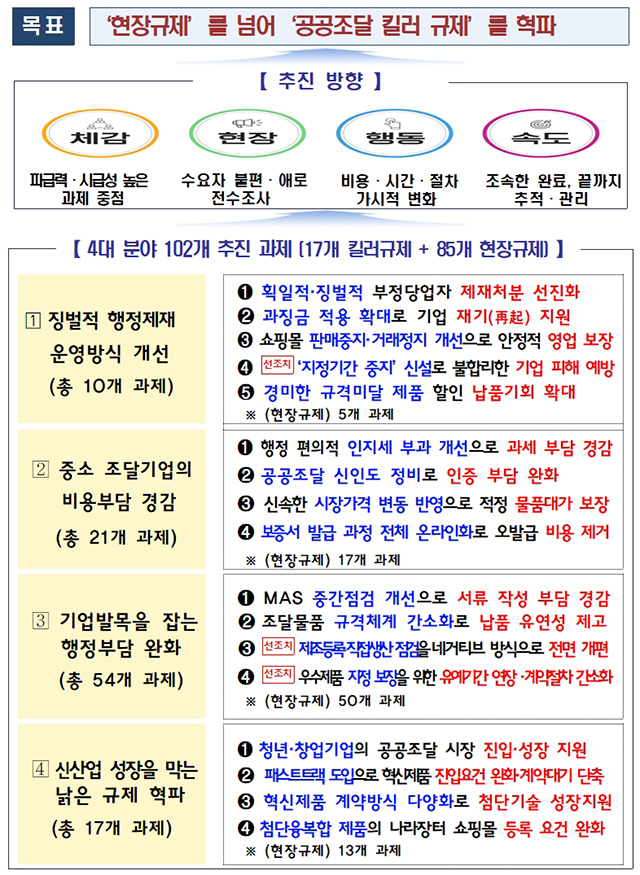
The biggest feature of this innovation plan is that it covers both "killer regulations" (17 cases) that have gone unresolved for years because they involve multiple ministries and sharp conflicts of interest, and "field regulations" (85 cases) — outdated practices hidden in day-to-day procurement work.
Of the 102 tasks in total across four areas in the "2024 Innovation Plan for Killer Regulations in Public Procurement," 17 are killer regulations and 85 are field regulations. The main contents are as follows.
First, the bid participation qualification restriction system, which has been centered on punishment, will be improved to align with global standards. The agency will refine exemptions from sanctions against unfaithful contractors and expand the scope of mitigation, currently limited to half of the penalty period. It aims to clarify and subdivide uniform sanction periods by specifying exemption grounds such as natural disasters and allowing additional mitigation based on the severity of the violation.
The basis for levying fines on annual unit-price contracts will be changed from the contract amount (the amount a company hopes to supply over the contract period) to the amount actually delivered, and the procedure will be simplified from four steps to three for faster decisions.
These improvements are expected to ease the burden on companies involved in roughly 200 lawsuits a year and to give companies more room to recover.
The plan also aims to ease unreasonable cost burdens that arise in the course of procurement transactions. The scope of contracts subject to stamp duty will be narrowed from all contracts to only those procurement contracts that fit the original purpose of the duty, and credit-rating requirements, which weigh heavily on procurement companies, will also be substantially overhauled. The stamp duty burden on some 16,000 cases a year is expected to be eased.
In addition, the plan seeks to streamline inefficiencies and complicated procedures hidden within the procurement process. Reflecting requests repeatedly raised at field discussion sessions, the number of mid-term inspections for MAS contracts will be cut from twice a year to once, easing the burden on more than 9,000 procurement companies.
Regarding the PPS's direct-production verification system, company-specific internal standard tables that had placed an excessive documentation burden on manufacturers will be abolished, and the criteria for determining direct-production violations will be overhauled into a negative-list system limited to cases such as delivering another company's finished product or subcontracting out the entire production process.
Finally, a forward-looking reform will be pursued to promote the growth of new industries. The limit for negotiated contracts will be significantly expanded so that young and startup companies can use public procurement as a growth ladder.
In response to the spread of the subscription economy in the private sector, various contract formats such as "leasing" and "subscription" will be introduced for innovative products. This is expected to further expand public-sector sales channels for high-priced equipment, such as medical and IT devices, and advanced convergence products.
PPS Administrator Lim Gi-geun said, "Swift implementation is the lifeblood of regulatory innovation. Of the 102 tasks in total, 40 have already been carried out, and for the remaining 62 we will swiftly revise the relevant contract laws and regulations to put them into practice, while doing our utmost on guidance, education and outreach so that procurement companies can fully understand these improvements. Going forward, with the mindset that a small drop of water can bore through a large rock, we will keep finding and rooting out unreasonable regulations and bring about real change on the ground in procurement."


0 Comments
No comments yet.