
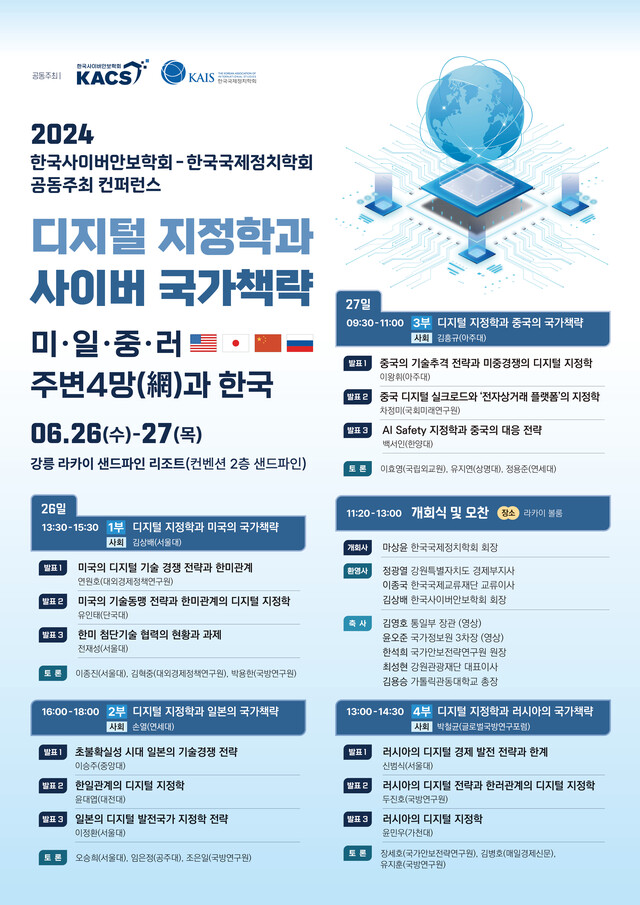
2024.06.25. The Fair Economy — The Korean Association of Cybersecurity Studies (KACS) and the Korean Association of International Studies (KAIS) announced that they will co-host a summer conference on the 26th and 27th at the Lakai Sandpine Resort in Gangneung, Gangwon Province, under the theme "Digital Geopolitics and Cyber Statecraft: The US-Japan-China-Russia Quadrilateral Network and Korea."
This conference follows a previous event held by the two associations on May 24 titled 'Cyber International Relations of the Four Neighboring Powers: Competition and Cooperation among the U.S., Japan, China and Russia.' It aims to promote exchange and collaboration among scholars and professional researchers working in the fields of cybersecurity and international politics.
The first session, themed "Digital Geopolitics and U.S. National Strategy," will feature presentations by Yeon Won-ho, research fellow at the Korea Institute for International Economic Policy; Yoo In-tae, professor at Dankook University; and Jeon Jae-seong, professor at Seoul National University, on topics including the U.S. digital technology competition strategy and Korea-U.S. relations, the U.S. technology alliance strategy and the digital geopolitics of Korea-U.S. relations, and the current status and challenges of Korea-U.S. advanced technology cooperation.
The second session, themed "Digital Geopolitics and Japan's National Strategy," will feature presentations by Lee Seung-ju, professor at Chung-Ang University; Yoon Dae-yeop, professor at Daejeon University; and Lee Jeong-hwan, professor at Seoul National University, on topics including Japan's technology competition strategy in an era of hyper-uncertainty, the digital geopolitics of Korea-Japan relations, and Japan's digital developmental state geopolitics strategy.
The third session, themed "Digital Geopolitics and China's National Strategy," will feature presentations by Lee Wang-hwi, professor at Ajou University; Cha Jeong-mi, research fellow at the National Assembly Futures Institute; and Baek Seo-in, professor at Hanyang University, on topics including China's technology catch-up strategy and the digital geopolitics of U.S.-China competition, the digital geopolitics of China's Digital Silk Road and e-commerce platforms, and the geopolitics of AI safety and China's response strategy.
The fourth session, themed "Digital Geopolitics and Russia's National Strategy," will feature presentations by Shin Beom-sik, professor at Seoul National University; Du Jin-ho, research fellow at the Korea Institute for Defense Analyses; and Yoon Min-u, professor at Gachon University, on topics including Russia's digital economy development strategy and its limitations, Russia's digital strategy and the digital geopolitics of Korea-Russia relations, and Russia's digital geopolitics.
At the opening ceremony preceding the four sessions, Ma Sang-yun, president of KAIS, will deliver the opening address.
Kim Sang-bae, president of KACS, will deliver a welcome address alongside welcome addresses by Jung Gwang-yeol, deputy governor for economy of Gangwon Special Self-Governing Province, and Lee Jong-guk, exchange director at the Korea Foundation.
Unification Minister Kim Yeong-ho and Yoon O-jun, third deputy director of the National Intelligence Service, will deliver congratulatory remarks via video, while Han Seok-hui, president of the Institute for National Security Strategy, Choi Seong-hyeon, CEO of the Gangwon Tourism Organization, and Kim Yong-seung, president of Catholic Kwandong University, will deliver congratulatory remarks in person.
Kim Sang-bae, president of KACS, explained the background of the two societies' collaboration, saying, "Contemplating national strategy for cybersecurity has now moved beyond the hands of cybersecurity experts and become a major concern for international politics scholars who ponder future digital national strategies."
He went on to diagnose the changes in the field of cybersecurity, saying, "Cybersecurity is expanding beyond the narrow realm of information protection and technical security into the broader issues of emerging technologies, the digital economy, and national security as a whole." He noted the significance of this, adding, "The historical fate of the Korean Peninsula, which has long had to consider its national survival and prosperity amid its four neighboring powers — the US, Japan, China and Russia — is being reflected in the formulation of cyber statecraft in the era of digital geopolitics."
Yoon O-jun, third deputy director of the National Intelligence Service, which is sponsoring the event, said, "Major countries are using digital technology as a strategic asset to strengthen their national security and economic interests." He added, "In this era of 'digital geopolitics,' the government is expanding its global leadership by strengthening cooperation with allied countries, and the NIS will also stand on the front line against cyber threats in step with this, including deterring malicious cyber activity through coordination with allied countries."
For more details about the joint conference, contact the KACS secretariat ([email protected], 070-8019-3590) or the KAIS secretariat ([email protected], 02-325-0372).


0 Comments
No comments yet.