
2024.07.17. The Fair Economy — The Ministry of Science and ICT announced on the 17th that it will fully push ahead with the 'Regional Autonomous Digital Service Development and Demonstration' support project based on regional demand to drive digital innovation in region-specific industries.
This project is part of the 'Regional Digital Re-creation Project' being promoted to systematically implement regional policy demands through the 'Regional Digital Competitiveness Enhancement Plan' announced by the Ministry of Science and ICT in November last year. It aims to develop and demonstrate new digital services linked to region-specific industries based on planning and proposals by local governments.
Reflecting each region's conditions and specialized fields, Daejeon, a central hub with multiple logistics centers, will tackle 'smart logistics'; South Jeolla Province, which has the largest area for fisheries and aquaculture, will focus on 'fishery spatial information'; and North Jeolla Province, home to the country's largest food industry cluster and a dedicated industrial park, will work on 'food technology.'
Hwang Gyu-cheol, software policy officer at the Ministry of Science and ICT, said, "As specialized data held by each region emerges as a new production factor in the digital era and its importance grows day by day, developing and demonstrating new digital services using such data in region-specific industries will be a meaningful means for regional economic and social innovation," adding, "I hope this project will pioneer future growth engines in the regions and serve as a foundation for driving new regional digital industries."
Demonstrating intelligent logistics technologies to innovate the logistics industry
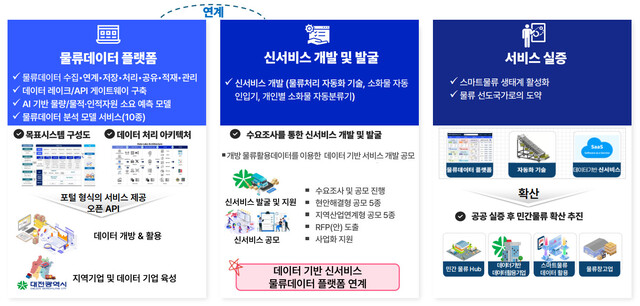
The intelligent logistics technology demonstration project aims to apply digital technology to the logistics industry to streamline logistics processing and discover new logistics-related services using collected and accumulated logistics data.
The project will build an online logistics data platform for collecting, analyzing, and sharing logistics data scattered across public and private sectors, as well as opening up public data. Based on this platform, it will develop 10 types of intelligent logistics new services in two categories: five 'issue-solving' services to address problems in the logistics field such as reducing labor intensity and managing work safety, and five 'regional industry-linked' services to enhance productivity in Daejeon's industries using robots and artificial intelligence (AI). It will support service development, demonstration, and commercialization for regional companies selected through a public competition.
The logistics data platform and intelligent logistics new services will first be demonstrated at the Central Regional Logistics Center of the Korea Post, which handles 25% of the nation's public parcel volume, before being expanded to private logistics companies. The project is expected to enable the digitalization of logistics data and the creation of high-value-added services linked to regional industries.
Building and utilizing an AI-based fishery spatial information big data platform
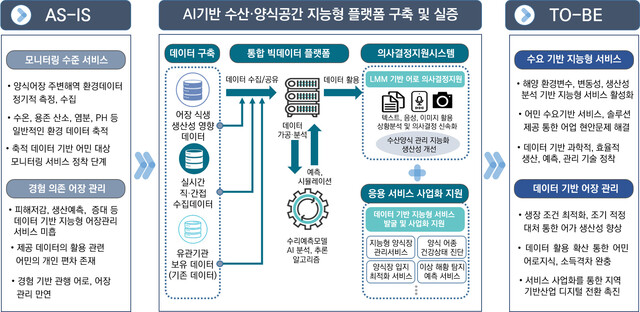
The AI-based fishing ground spatial information big data platform project aims to collect and accumulate marine environment and physical data and growth data of aquaculture species, and to discover new services related to fisheries and aquaculture based on the collected big data.
It will build an intelligent fisheries and aquaculture platform using big data collected and integrated from related agencies such as the National Institute of Fisheries Science and the Korea Hydrographic and Oceanographic Agency, including marine environment and marine physical data and growth data of laver and abalone, representative aquaculture species in the southwestern coastal region of South Jeolla Province. Based on this, it will support the development of an AI-based decision support system that can assist decision-making throughout fisheries and aquaculture activities.
The big data platform will be used to solve regional fisheries and aquaculture issues through new service development and demonstration, such as predicting high water temperatures and early prediction of low-salinity water or yellowing phenomena to reduce laver and abalone mortality. It is expected to contribute to overcoming crises in the fisheries and aquaculture industry, such as abnormal climate and a decline in the fishing population, by applying data-based innovative technology in a field traditionally reliant on experience and practices.
Supporting metaverse-based technology demonstration in the agriculture and food sector
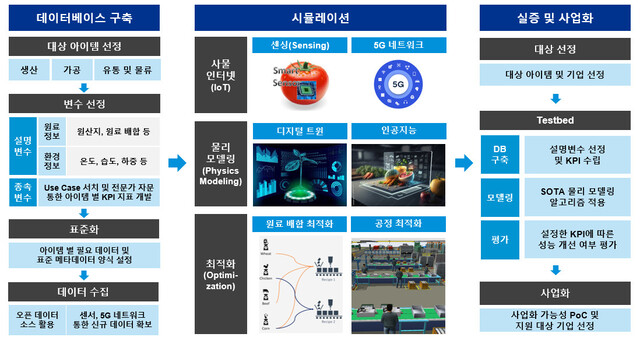
The metaverse-based technology demonstration support in the agri-food sector is a project that uses virtual convergence world (metaverse) technology in the agri-food industry to virtualize food manufacturing processes and derive optimized process models through simulation of manufacturing processes in the virtual world.
Utilizing infrastructure supporting food companies within the National Food Cluster (Iksan, 2.32 million sq m), a specialized industrial park for the food industry, the project will build a digital integrated platform for food technology. This platform will collect, analyze, learn from, and utilize broad food sector data, ranging from raw material production to manufacturing processes, including data collected for each manufacturing step such as formulation and packaging, as well as raw material data held by participating institutions like the Korea Food Research Institute and the National Institute of Agricultural Sciences. Based on this platform, it will support the development and demonstration of new food technology services.
In particular, for food manufacturing process areas with high demand from food manufacturers (alternative meat, sauces, beverages, and packaging), it will virtualize manufacturing facilities and processes using digital technology and support deriving optimized food production process models through simulation of food manufacturing processes using virtualized metaverse models.
The food technology industry is growing rapidly, but applying digital technology to food technology has faced difficulties such as data dispersion and the need for direct use of expensive facilities and equipment. This project is expected to contribute to fostering food technology as a new growth industry through metaverse-based digital technology innovation.


0 Comments
No comments yet.