
2024.07.17. The Fair Economy — The Ministry of Science and ICT and the Ministry of National Defense have agreed to strengthen inter-ministerial cooperation, including expanding the eligibility for the science and technology officer program from the current bachelor's degree level to master's degree level, in order to 'promote science and technology and digital innovation and build an elite advanced strong military.'
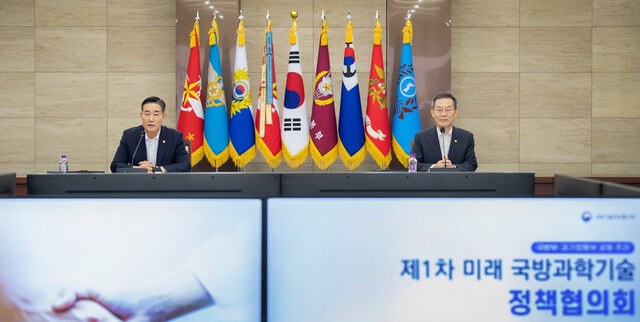
The two ministries announced that they jointly hosted the '1st Future Defense Science and Technology Policy Council' on the 17th at the Ministry of National Defense's main conference room.
The two ministries signed a memorandum of understanding on April 1 to build an elite advanced military prepared for South Korea's science and technology and digital innovation and future warfare environments. Since then, they have reviewed and discussed practical cooperation plans by subcommittee, including research and development (R&D), digital and artificial intelligence (AI), and space.
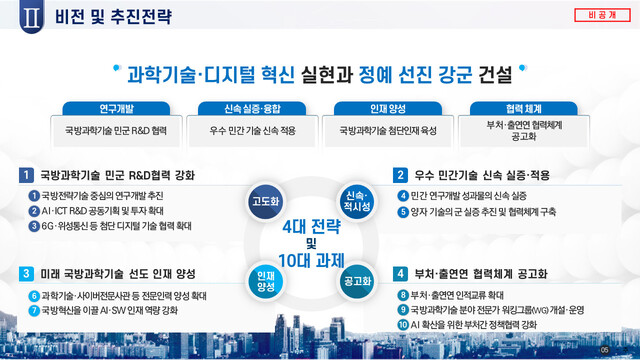
At the meeting, the two ministries discussed four major strategies and key tasks based on the cooperation plans identified so far and agreed to establish a close cooperation system between them.
Lee Jong-ho, Minister of Science and ICT, said, "As the impact of technologies such as drones, AI, and robots on the battlefield continues to grow, the two ministries will strengthen comprehensive cooperation in technology collaboration, demonstration, and workforce training and exchange through the policy council to promote the development of science and technology and information and communications and to foster an advanced strong military."
Shin Won-sik, Minister of National Defense, emphasized, "The Ministry of National Defense will cooperate with the Ministry of Science and ICT in various fields to increase the momentum for building an AI science and technology strong military," and added, "Through the cooperation of the two ministries, we will work to create a virtuous cycle between national security and technological development and further strengthen the capabilities of defense science and technology."
Strengthen civil-military technology cooperation to elevate the level of defense science and technology
First, civil-military technology cooperation will be strengthened to elevate the level of defense science and technology and expand domestically developed independent technologies.
Specifically, R&D will be promoted to upgrade mature private sector technologies with potential military application to levels meeting military requirements and specifications. Innovative and high-impact technologies expected to be applied in future battlefields, such as AI, semiconductors, and radiation, will be demonstrated and developed to strengthen defense capabilities while also accumulating and reinforcing private sector technological capabilities in fundamental fields.
In addition, the possibility of joint civil-military use of candidate frequency bands for 6th generation (6G) communication will be verified. As demand for civil and military frequencies is expected to surge for manned and unmanned systems, robots, and drones, inter-ministerial cooperation for efficient frequency utilization in advanced fields will also be strengthened.
Furthermore, technology cooperation in the field of low Earth orbit satellite communications, a core infrastructure for next-generation networks, will be strengthened to achieve seamless communication from ground to sea and air.
Establish a system to quickly apply outstanding civilian R&D achievements to the military
A system will be established to rapidly apply and inspect excellent private sector research and development (R&D) outcomes, quantum technologies, and other innovations for the military.
The ministries decided to identify civilian technologies applicable to the defense sector held by research institutes under the Ministry of Science and ICT and others, and to promote joint pilot demonstration projects to actually apply them to the military. To this end, they will mutually utilize civil, government, and military research infrastructure, including test facilities owned by the two ministries and research institutes.
Also, institutional mechanisms such as security verification systems will be established for the demonstration of quantum cryptographic communications in the defense sector. The 'Civil-Military-Industrial Quantum Information Council' will be actively utilized to promote close exchange of quantum technology information between the two ministries.
Continuing Cooperation on Science and Technology Talent Development and Capability Enhancement
Cooperation for science and technology talent development and capability enhancement will continue, including cultivating science and technology and cyber specialists to lead future defense science and technology, and expanding education to strengthen the AI and software (SW) capabilities of military personnel.
To enable outstanding university students in science and engineering to continue research at the Agency for Defense Development, the eligibility for the science and technology officer program will be expanded from the current bachelor's degree level to master's degree level, and cyber officer candidates will be selected from students at five domestic information security specialized universities, including KOREA University Sejong Campus, Sejong University, Sungshin Women's University, Chonnam National University, and Chungnam National University, to strengthen the training of military cyber experts.
To enhance the education and capabilities of military specialists and industrial reserve personnel (those scheduled for discharge), MSIT-designated software-centric universities will be matched with nearby military units to actively support military personnel in receiving specialized SW education.
Expand personnel exchanges between ministries and research institutes
To solidify the cooperation system between the two ministries and their subordinate research institutes, personnel exchanges between ministries and personnel exchanges by technology field between research institutes will be expanded. Inter-ministerial policy cooperation for the diffusion of AI will also be strengthened.
A joint industry-academia-research-military expert working group will be established and regularized to identify promising defense science and technologies and plan R&D projects, focusing on 10 major defense strategic technology fields including AI, quantum, space, and energy.
Personnel exchanges between ministries and government-funded research institutes will also be promoted to enhance mutual understanding and create synergies.
In particular, to promote the diffusion of AI in the defense sector and increase the utilization of related technologies in the private sector, close cooperation is planned for policy research and technical R&D on AI security, AI safety, and stable power supply solutions for surging AI usage.


0 Comments
No comments yet.