
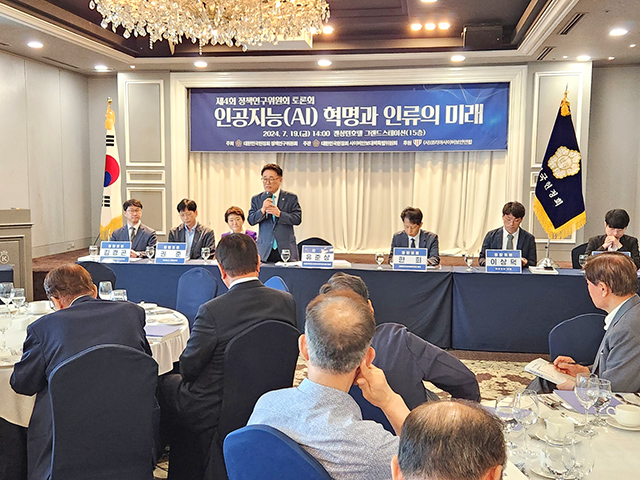
2024.07.20. The Fair Economy — The Policy Research Committee and the Special Committee on Cybersecurity Measures of the Constitutional Assembly of the Republic of Korea held a forum on the theme of "The Artificial Intelligence (AI) Revolution and the Future of Humanity" at the Grand Station of the Kensington Hotel in Yeongdeungpo-gu, Seoul, on the 19th.
According to the organizers, Yoo Jun-sang, chairman of the Constitutional Assembly's Special Committee on Cybersecurity Measures, moderated the session. Choi Jae-bung, a professor at Sungkyunkwan University, delivered a keynote speech on "Survival Strategies in the Age of AI Sapiens," while Lim Jong-in, special cyber advisor to the presidential office, spoke on "AI Threats and Opportunities."
Professor Choi Jae-bung said, "Digital transformation has evolved, and human civilization has entered the era of generative AI. It is necessary to establish R&D strategies and visions centered on generative AI, and generative AI software, AI semiconductors, and AI application technologies must converge," emphasizing, "We must establish a digital worldview and study the changes brought by AI."
Adviser Lim Jong-in said, "As recent cyber warfare and cyberattack cases show, cyber resilience, which includes not only preemptive defense but also rapid response and recovery, has become more important. In addition, as malicious uses continue with the rapid advancement of AI, regulatory measures must be sought. For the future of humanity, we must also pay steady attention to quantum computers, space and satellites, biotechnology, international cooperation, and digital solidarity, and prepare related policies."
Following the keynote speeches, a general discussion was held with Han Hui, president of Seoul Media Institute of Technology; Kwon Eun-hui, co-representative of the Korea Cyber Security Union; Kwon Jun, editor-in-chief of Boan News; Kim Kyung-gon, a professor at Naif Arab University for Security Sciences; Lee Sang-deok, deputy editor at Maekyung AX; and Lee Jong-ho, leader of Toss's security technology team, among others.
President Han Hui expressed, "Deep reflection is required on human adaptation to AI advancement: first, AI replacing existing human roles and then the next roles for humans; second, the acceleration of surplus value concentration due to AI; and third, threats arising from incompleteness amid AI technological evolution."
Co-chair Kwon Eun-hui suggested, "To achieve an AI revolution beneficial to humanity, first, establish AI ethics and safety standards and introduce regulations with legal binding force; second, enhance transparency and accountability in AI use; and third, pursue human-centered AI design."
Editor‑in‑chief Kwon Jun said, "Participating in RSA, the world's largest security conference held in the United States this year, I felt that AI and security have become even more closely intertwined since the pandemic. The promotion of security products by global giants such as Google, Microsoft, IBM, and CISCO was impressive. Korea's information security industry must also move beyond a focus on small and medium enterprises and attract active investment from large corporations."
Professor Kim Kyung‑gon said, "We must consider ways to use AI correctly and minimize side effects. Rather than AI and humans competing, we should move toward coexistence and mutual complementarity, where each enhances the other's capabilities."
Deputy Chief Lee Sang-deok emphasized, "The risks of AI have become widely known through violations of the National Security Act, deepfakes of politicians, and so on. In response, the EU is making efforts to secure safety against AI risks through the world's first AI law, and the United States through an AI executive order. Our country should also promptly push for legislation of the AI Basic Act."
"While AI has made life more convenient, it has increased risks from a security perspective. AI has created an environment where even non-experts can easily hack systems. Technical and institutional responses to protect against these risks are important," Lee Jong-ho stated.
The forum was attended by key figures including Joo Ho-yeong, vice speaker of the National Assembly; Jung Jeom-sik, chairman of the People Power Party's policy committee; Jin Seong-jun, chairman of the Democratic Party of Korea's policy committee; Hwang U-yeo, chair of the People Power Party's emergency response committee; Lim Jong-deuk, lawmaker of the People Power Party; Jung Dae-cheol, president of the Constitutional Assembly; and Jung Chang-rim, policy officer for information security networks at the Ministry of Science and ICT.
Chairman Yoo Jun-sang, who organized the forum, explained the purpose and significance of the event, saying, "We need national policies to lead the AI era, and for that, we must gather bipartisan strength regardless of ruling or opposition parties. This is a time when the National Assembly, government, industry, academia, and the media must put their heads together to create policies and strategies for a better country. An unpredictable era in which AI can emerge as an alternative to humans is precisely the future of humanity. We must wisely navigate the period when AI's threats and opportunities coexist and turn it into an opportunity for human development and prosperity."
Prior to the forum, a publication ceremony was held for the Constitutional Assembly's policy booklet, "The Path to a Proud, Advanced and Strong Republic." Jung Dae-cheol delivered a welcome address, while Joo Ho-yeong, Jung Jeom-sik, and Jin Seong-jun gave congratulatory speeches.


0 Comments
No comments yet.