
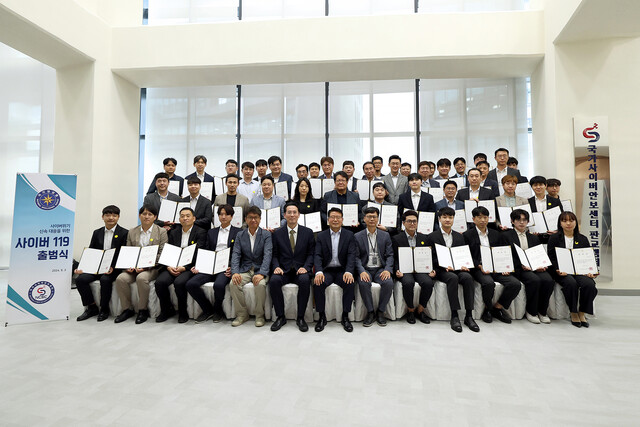
2024.08.02. The Fair Economy — The National Intelligence Service announced on the 2nd that it held a launch ceremony for 'Cyber 119,' involving 46 institutions including government ministries such as the Ministry of Science and ICT, the Prosecution Service and the police; local governments such as Busan, Daejeon, Gwangju and Daegu; and public institutions such as Korea Electric Power Corporation, Korea Hydro & Nuclear Power, and the Korea Internet & Security Agency (KISA).
According to the NIS, the participating organizations received letters of appointment for 'Cyber 119' issued in the name of the NIS director, were divided into five regions — the Seoul metropolitan area, Chungcheong, Yeongnam, Honam, and Jeju — and began full-fledged activities.
Last November, when a disruption of the administrative network and other e‑government service outages occurred, the Rapid Response Team under the National Cyber Crisis Management Unit was dispatched to the site to investigate the cause of the outage, including whether it was a hack, and to restore services and stabilize the system.
Since then, there have been ongoing calls for the establishment of a regional rapid response system that can approach large‑scale cyber incidents or hacking attacks from a security perspective, enabling deployment and crisis response within the golden hour.
Accordingly, the NIS divided the country into five regions and launched a joint response consultative body involving about 130 cyber experts in each region.
'Cyber 119' operates on a non-regular basis during peacetime. It is activated when the NIS requests its mobilization in a given region in the event of large-scale cyber incidents, such as the paralysis of major information and communication networks or information systems, large-scale intrusion incidents, or attacks by state-backed hacking organizations involving multiple institutions. Upon activation, it works organically with the National Cyber Crisis Management Team.
A local government official participating in 'Cyber 119' suggested, "To strengthen regional rapid response capabilities, regular training and education are also needed."
Shin Yong-seok, Cyber Security Secretary at the National Security Office, said in a congratulatory address that day, "As the existing regional cybersecurity councils have grown into the nationwide council known as 'Cyber 119,' future cyber crisis response activities will be upgraded a step further," expressing his expectations.
Yoon O-jun, third deputy director of the NIS, stated, "We will actively support the establishment of a wide-area rapid response system centered on the consultative body to faithfully fulfill the role of cyber firefighters."


0 Comments
No comments yet.