
2024.07.09. The Fair Economy — The government will prevent the creation of illegal spam accounts, the activation of burner phones, and identity theft — all exploited as tools of voice phishing crime — while expanding ways for the public to recognize and avoid voice phishing. It will also swiftly block the lines used in crimes when they occur, and build a response system that makes use of AI technology.
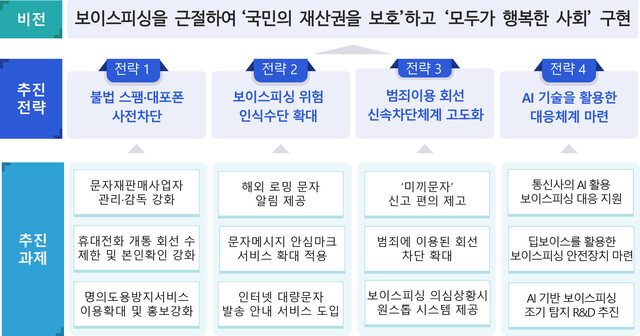
The Ministry of Science and ICT announced on the 9th that the Joint Task Force on Eradicating Voice Phishing and Illegal Finance (chaired by the State Council Office Director) has released a plan to address voice phishing in the telecommunications sector, comprising four major strategies and 12 tasks. The move aims to prevent communication services from being abused as tools for voice phishing and to proactively respond to emerging criminal tactics, as digital new technologies have made these crimes more sophisticated and cunning.
The scale of voice phishing damage has been on a downward trend since 2022, but this year has seen a sharp rise in bait texts and spam messages along with the emergence of new types of crime, creating a need for additional measures. The latest telecom-sector countermeasures flesh out the tasks announced in February through the Government-wide Task Force on Countering Voice Phishing, and add new tasks aimed at preemptively responding to the misuse of artificial intelligence (AI) technology.
Minister of Science and ICT Lee Jong-ho said, "Voice phishing crimes approach victims through telecom services, so it is above all important to preemptively block the means of crime, such as burner phones, to prevent them. The Ministry of Science and ICT plans to continuously develop countermeasures to respond to evolving voice phishing methods and work to eradicate voice phishing."
Raising entry requirements for the text resale business
The text-sending market, worth roughly 2 trillion won (about $1.4 billion) a year, has seen nearly 1,200 text resale businesses spring up due to low entry barriers, with illegal spam texts being distributed in bulk as these businesses chase profit — a situation requiring strong measures to prevent harm to users. The ministry plans to raise entry requirements so that only capable operators can enter the text resale business, and to strengthen oversight of business operations through on-site inspections and corrective orders, easing the public's fatigue from illegal spam.
In addition, to block the mass activation of burner phones — a key tool of voice phishing crime — the restriction period on subscribing to multiple lines under the same name will be extended from the current 30 days to 180 days, sharply cutting the number of mobile lines a person can activate per year (from 36 lines a year to six). Identity verification at activation will also be strengthened: in addition to checking text information (name, resident registration number, issue date, etc.), the process will use ID photos held by government agencies to verify photo authenticity as well.
On top of this, as cases of burner phone activation through identity theft have risen amid recent personal data leaks, the ministry plans to step up promotion of the Identity Theft Prevention Service (M-safer), which makes it easy to prevent illegal use of mobile phones under one's stolen name, so as to expand public use of the service and prevent harm particularly to vulnerable groups such as the elderly.
Expanding ways to recognize voice phishing risks
As damage from a new scheme that exploits overseas roaming services to send texts impersonating acquaintances has recently been rising, the ministry plans to add a "[Roaming Sender]" notice to roaming phone texts, in addition to the existing "[International Text]" notice for messages sent from abroad, so people can immediately recognize and avoid phishing texts that impersonate family members or acquaintances in Korea sent from overseas.
In addition, the ministry plans to expand the "Safe Mark Labeling Service" to texts sent by public institutions and financial companies, and apply additional anti-forgery technology to the safe mark, so the public can trust messages sent by such institutions. It will continue working toward adoption by all public institutions and financial companies in the future.
The ministry also plans to send a notification text to the actual owner of a phone number whenever illegal texts (such as voice phishing bait messages or illegal investment solicitations) are sent using that person's stolen number, so the owner can quickly recognize the identity theft and prevent further harm.
Upgrading the rapid-blocking system for lines used in crime
Since a complicated reporting procedure can discourage people from reporting suspicious calls or texts such as voice phishing or smishing, the ministry plans to make reporting easier by introducing a simple phishing-report button on mobile devices, following the earlier introduction of a "Spam Report" button. This is intended to prevent further harm from spreading through swift reporting and blocking.
Also, to prevent further crimes from occurring through unblocked lines and accounts of illegal users that had existed in a regulatory blind spot, the ministry plans to strengthen its phone-number blocking policy. Going forward, if a caller or sender falsifies the originating number to make a call or send a text, not only that line but all connected phone lines and text-sending accounts will be blocked.
Building an AI-based response system for voice phishing
With the emergence of new voice phishing methods such as deepfake voice that exploit digital technology, it has become difficult for individuals to detect voice phishing on their own. Therefore, developing voice phishing detection technology using AI and data is of utmost importance. To this end, the government plans to provide 'criminal call data' held by the Financial Supervisory Service to the private sector to accelerate the commercialization of AI-based phishing detection technology, and to pursue the institutionalization of voice watermarking to prepare for the possibility of voice phishing using deepfake voice.
The ministry also plans to upgrade its response capabilities by pursuing an "AI-based early voice phishing detection R&D" project, which will actively and preemptively detect and swiftly block various new types of voice phishing schemes directly on devices.
"Block fly-by-night businesses and secure AI accuracy"
Regarding the announcement of these plans, information and communications technology (ICT) experts pointed out that the Ministry of Science and ICT needs to pay close attention to policy details to ensure substantive policies are established and operated.
Value-added telecommunications operators pointed out that the reason the number of text resale businesses has climbed to nearly 1,200 is that business registration is too easy, and that the government, by making registration this easy, has itself contributed to the flood of spam texts and voice phishing.
Speaking on condition of anonymity, these operators said, "If registration required paying an appropriate amount in deposits or surety insurance, it would be possible to filter out malicious operators that send illegal texts in bulk like 'fly-by-night' outfits. If an operator is fined or ordered to pay a penalty surcharge or administrative fine during business operation and fails to pay, the amount could be deducted from the deposit or covered by the surety insurance. Checking whether administrative sanctions are pending at the time of business closure, and returning the deposit only after such sanctions are concluded, would prevent hit-and-run-style operations."
Responding to this suggestion, a Ministry of Science and ICT official said, "We will consider measures — such as requiring deposits or surety insurance — to help text resale businesses operate soundly."
Regarding AI-based voice phishing detection technology, opinion emerged that "accuracy" is what matters most.
An ICT engineer based in the Seoul metropolitan area told The Fair Economy, "AI is not a panacea. For example, the Railroad Special Judicial Police under the Ministry of Land, Infrastructure and Transport has been implementing a project since last year to install AI CCTV at major railway stations nationwide, investing 10 billion won (about $7.2 million) annually for three years, totaling 30 billion won (about $21.7 million). However, that project set the target for AI CCTV recognition accuracy at 75%, which has raised concerns about soaring false positive rates. In the ministry's final report on the 'intelligent railway crime prevention video analysis platform construction,' released during last year's parliamentary audit, it was concluded that the core function, 'abnormal behavior analysis,' is unsuitable for busy railway environments."
He further expressed concern, "The government plans to use 'on-device AI' built into smart devices to detect voice phishing to fundamentally block the possibility of personal information leakage. However, if the performance of on-device AI is insufficient, the false positive rate for voice phishing could rise, potentially leading to 'AI falsely accusing innocent people.'"
The Fair Economy asked the Ministry of Science and ICT what target level of recognition rate and accuracy it has set for the AI-based early voice phishing detection R&D project, but the ministry avoided giving a direct answer.


0 Comments
No comments yet.