
2024.07.20. The Fair Economy — Revenue from value-added telecommunications businesses reached an estimated 328.5 trillion won last year, a survey found. Both app market operators and users largely supported allowing 'sideloading,' the distribution of apps through third-party app markets or websites.
The Ministry of Science and ICT recently announced the results of the '2023 Value-added Telecommunication Business Survey' on this matter.
According to the Ministry of Science and ICT, this survey aims to identify the status of the value-added telecom market, including digital online platform-based (platform) systems that are gaining social and economic influence, in order to develop market activation policies, and has been conducting value-added telecom business surveys since 2021 in accordance with Article 34-2 of the Telecommunications Business Act.
The 2023 survey shifted from a full census to a sample survey. In addition to a general status survey, it conducted user perception surveys on eight types of digital platforms and surveys on the usage behavior of value-added telecommunications businesses regarding app markets and internet-based resource sharing (cloud) to understand how infrastructure and platforms are being used.
The eight types of digital platforms are social media, messengers, search, taxi-hailing, food delivery, accommodation, e-commerce, and app markets.
"The survey on the state of the digital platform market is a starting point for advancing sound platform policies. We will continuously grasp the characteristics of each specific platform market, which are becoming increasingly important in people's daily lives, and actively pursue policies tailored to those characteristics," said Lee Do-gyu, director of communications policy at the Ministry of Science and ICT.
Value-added telecom revenue reaches 328.5 trillion won
Among the 1,501 value-added telecom service providers surveyed (2022), the market composition, based on representative services, was as follows: services such as food delivery and finance accounted for 31.8%; goods such as e-commerce accounted for 29.0%; and content such as search and gaming accounted for 15.4%, in that order.
Additionally, 46.7% of operators were found to provide value-added telecom services across two or more categories.
Among value-added telecom service providers, 'digital platform' operators—those whose revenue is generated through intermediary services—accounted for 36.1%, or 475 companies. They operate in services (35.8%), content (24.2%), and goods (18.7%), and it was found that each operator typically provides services across an average of three or more categories.
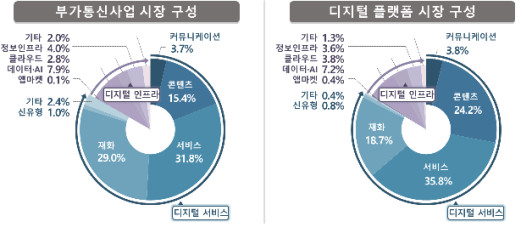
Value-added telecom business revenue is estimated at 328.5 trillion won, of which digital platform revenue is estimated at 114.4 trillion won.
The average monthly active user count of the top operators by type (based on representative services, three-month average) was as follows: content (37.187 million), app market (23.762 million), communication (20.812 million), services (16.389 million), goods (13.471 million), new types (1.804 million), and data and artificial intelligence (AI) (934,000).
The rate of new technology adoption was 43.4% for value-added telecommunications businesses and 73.5% for digital platform businesses, with platform businesses showing a rate about 30 percentage points higher. However, the technologies used were identical in order: big data, AI, and cloud.
Additionally, it was found that data is being collected and used for purposes such as customer management, marketing, and improving existing products or services.
The main difficulties encountered while operating value-added telecommunications businesses, including digital platforms, were ranked as follows: securing specialized personnel in the latest technologies, burden of infrastructure costs, and intensifying competition with global companies and big tech firms.
App markets show low multi-homing and switching rates, indicating 'lock-in'
A user survey on usage behavior across major platform types, conducted among 2,500 adults nationwide, found that more than 90% of respondents used search platforms (98.2%), messengers (98.0%), and e-commerce (96.0%). App markets (84.6%) and social media (SNS) (84.0%) were also relatively widely used.
Looking at the 'main service' results, Naver (52.7%) for search portals, KakaoTalk (93.5%) for messengers, Kakao T (86.6%) for taxi-hailing, and Baedal Minjok (64.9%) for food ordering showed high usage rates.
For e-commerce, the proportion of users who used two or more digital platform services in the past three months and the proportion who switched their main service within the last year were both relatively high. In contrast, app markets had the lowest multi-homing and switching rates, indicating a significant lock-in effect.
Multi-homing refers to users simultaneously using multiple platforms.
Lock-in refers to the phenomenon where consumers who become accustomed to a specific product or system limit themselves from choosing other products.
59% of app market users are aware of price differences based on the app payment method. When asked about willingness to use external payments, 44.3% of all respondents said they would if the outlink method were allowed, and 46.1% said they would if in-app payment method guidance were permitted.
A majority of Apple Inc. (App Store) users said they would download and use apps through other app market operators (62.2%) or websites (57.6%) if sideloading were allowed.
Sideloading refers to the distribution of apps through app markets or websites other than the app market operated by the mobile OS provider.
Positive on sideloading…"Security issues can be addressed"
Results from a survey on app market and cloud usage behavior, which received responses from 542 app market users and 171 cloud users among value-added telecommunications businesses, showed that the preferred app markets were Google Play (75.1%) and App Store (Apple Inc., 16.8%). The main reason for preference was the large total user base (71.4%).
Most respondents supported allowing sideloading through third-party app markets and websites. Regarding sideloading, they expressed concerns about security issues but perceived that appropriate responses could be made.
Among the 171 cloud service providers, only 31 had experience switching cloud services, and only 7 (5%) had plans to switch, indicating a high dependence on their current cloud.


0 Comments
No comments yet.