
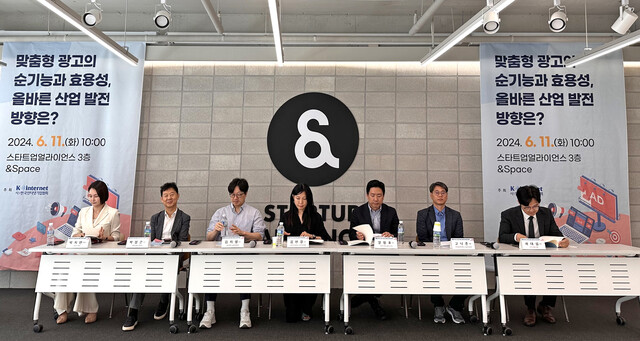
2024.06.11. The Fair Economy — K-Internet said it hosted a debate titled "What Are the Benefits and Utility of Targeted Advertising, and What Is the Right Direction for Industry Development?" on the 11th at Startup Alliance in Gangnam-gu, Seoul.
The debate opened with a presentation by Jeong-Eun Park, a professor at Ewha Womans University's College of Business, titled "Proposals on the Dual Nature of Online Targeted Advertising and a Path for Its Development."
Professor Jeong-Eun Park said, "Online targeted advertising has the advantage of making purchases easy and fast for consumers, and for businesses, the low rate of ad rejection and fatigue means they can expect high consumer acceptance, but there is also a concern that consumer privacy may be infringed. According to research findings, consumers are concerned about privacy infringement but positively evaluate the convenience of targeted advertising."
She then stressed that "when establishing policies, it is necessary to examine them from the consumer's perspective" and expressed hope that "policies on online targeted advertising will also be implemented in a tailored manner reflecting consumer characteristics."
She concluded her presentation by emphasizing, "Innovation means moving in a better direction, and we live in an era of online innovation. For innovation, the parties involved need to make proper efforts with consumer-centered consideration, and this is a time when the government needs to make the effort to simply watch and let it happen."
The second presenter, attorney Park Ji-yeon of Bae, Kim and Lee LLC, began her presentation on the topic of "Legal Issues Related to Targeted Advertising."
Lawyer Park Ji-yeon emphasized, "When setting the direction for regulating targeted advertising, it is necessary to consider various circumstances, including the perspective of personal information protection, the economic effects that can be obtained through targeted advertising, and the impact of regulation on the online ecosystem. A cautious approach is needed to prevent the ecosystem from contracting due to excessive regulation of targeted advertising."
She also expressed concern that "under current domestic law, there is a lack of clear standards regarding whether online identifiers constitute personal information, who among advertising businesses and web/app businesses qualifies as a personal information controller, and when and how consent must be obtained."
She further emphasized, "It is necessary to devise effective measures through in-depth review of overseas cases, such as the U.S.'s ex-post control and Japan's introduction of new concepts, as well as the domestic situation."
The subsequent general discussion was moderated by Kim Hyeon-gyeong, a professor at Seoul National University of Science and Technology's Graduate School of IT Policy.
First, Kim Ji-yeong, a professor in the Department of Global Business Administration at Sungkyunkwan University, said, "Broadly speaking, targeted advertising falls under innovative business. At a time when a nation's digital capabilities are becoming increasingly important, it is a key industry that helps small and medium-sized businesses grow."
She added, "There is research confirming the positive effects of targeted advertising, such as reducing advertising costs and preventing excessive competition."
Moon Jang-ho, a professor in the Department of Public Relations and Advertising at Sookmyung Women's University, said, "Targeted advertising represents a democratization of advertising, creating an environment in which anyone—including small and medium-sized enterprises and small business owners—can easily run ads." He stressed, "In that it enables free services, it can be called a source of nourishment for the growth of the digital technology industry."
He added, "On the issue of privacy infringement, applying an opt-out method, as the United States does, would be effective, and discussion should continue on striking a balance between promoting the digital advertising industry and protecting users' privacy."
Kwak Dae-seop, a team leader at the Korea Digital advertising Association, said, "The development of digital advertising, which allows for efficient use of advertising budgets, is helping small and medium-sized advertising businesses grow." However, he expressed concern, saying, "If advertising IDs and behavioral information used in targeted advertising come to be classified as personal information due to privacy protection issues, there are concerns that the business model itself could disappear, so policy support is needed to help small and medium-sized advertising businesses reduce their legal risk."
The final discussant, Ko Nak-jun, head of the New Technology Personal Information Division at the Personal Information Protection Commission, said, "The PIPC is basically giving sufficient consideration to the positive functions of targeted advertising," and added, "We will carefully consider the impact of advertising on the economy and establish guidelines through smooth communication with businesses."
Moderator Kim Hyeon-gyeong closed the discussion by saying, "The industry is quite concerned, perceiving guidelines as a form of regulation as well. As the saying goes, regulatory failure is more dangerous than market failure, and I hope that these guidelines, through careful review, can become a policy that achieves both personal data protection and industry promotion."


0 Comments
No comments yet.