
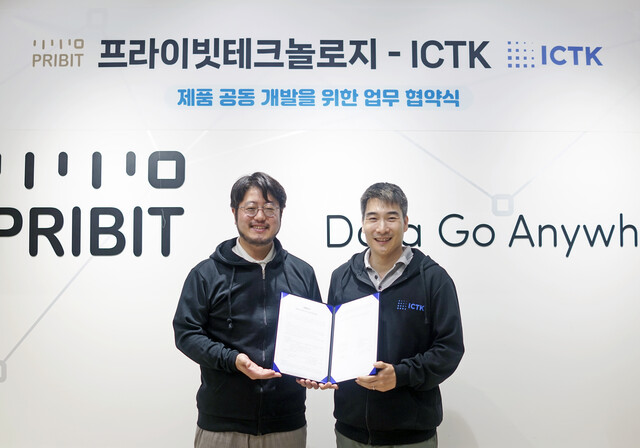
2024.07.05. The Fair Economy — PrivateTech (CEO Kim Yeong-rang) and ICTK (CEO Lee Jeong-won) announced on the 5th that they signed a memorandum of understanding (MOU) for joint development of security products that combine their technologies and solutions.
According to PrivateTech, the two companies will combine ICTK's physical unclonable function (PUF) technology with PrivateTech's Secure Access Service Edge (SASE) product through this MOU, and cooperate on developing business models for market expansion, marketing for product promotion, and other related activities.
The SASE product that combines the two companies' technologies is expected to incorporate PUF technology as a multi-layer security model (MLS) supporting element. When users and devices access resources, systems, and data at the highest security level, the edge between the user, device, and protected resource will authenticate the identity of trusted entities.
As new cyber threats that are difficult to address with traditional perimeter security models increase, the need for a Zero Trust-based multi-layer security model to complement them is emerging.
Zero Trust is a security framework that verifies the data movement process of all users and devices attempting to access protected resources, based on the principle of not trusting any entity inside or outside the organization. The global Zero Trust security market is expected to grow to 132.2 trillion won (about $95 billion) by 2030.
ICTK's PUF technology, which makes forgery and tampering fundamentally impossible, provides the highest level of security elements for authenticating the identity of users and devices. Combined with Privatetech's data flow technology, it blocks data access by unauthorized or untrusted entities along the data movement path.
Additionally, PrivateTech will create a data packet encryption-based tunnel that combines post-quantum cryptography (PQC) and the Korean Cryptographic Module Validation Program (KCMVP) solutions, showcasing quantum security-based data movement path control technology. The company expects that the combination of Zero Trust, hailed as a next-generation security approach, with quantum cryptography will enable a more robust and secure security model.
In particular, as both companies hold more than 130 patents each and are focusing on independent technology development, they are accelerating the development of a next-generation security platform with a target launch in the second half of this year. Based on this, they plan to aim directly at the U.S. market, the home country of Zero Trust.
"We are highly excited to be able to unveil a next-generation security solution that integrates the technological capabilities of both companies," said Kim Yeong-rang, CEO of Private Technology. "While focusing on implementing a safer and more reliable security environment, we will do our best to ensure competitiveness in the global market as well."
"We are very pleased to be developing an innovative security solution with Private Technology through this agreement," said Lee Jeong-won, CEO of ICTK. "By combining the technical capabilities of both companies, we will strive to present a new cybersecurity paradigm and provide a security solution trusted worldwide."


0 Comments
No comments yet.