
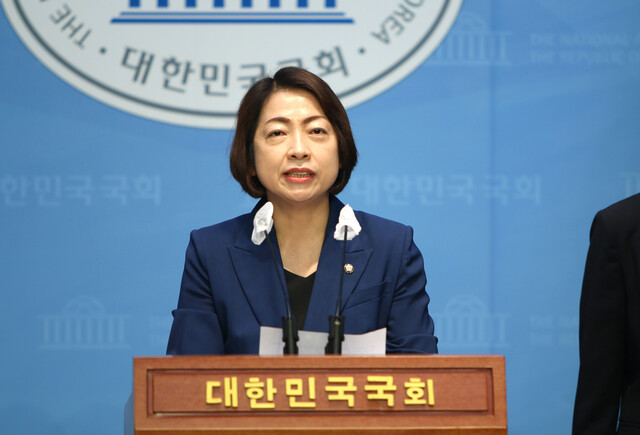
2024.07.08. The Fair Economy — Rep. Hwang Jeong-a, a member of the National Assembly's Science, ICT, Broadcasting and Communications Committee, announced on the 8th that she had introduced the "R&D Investment Support Act" (a partial amendment to the Restriction of Special Taxation Act) as lead sponsor, aiming to expand tax benefits for research and workforce development expenses in order to encourage companies to invest more actively in research and development (R&D).
According to Rep. Hwang's office, the current Restriction of Special Taxation Act allows companies to deduct a set percentage of expenses used for research and workforce development from income tax or corporate tax.
However, critics have pointed out that, given the success rate of R&D projects, the current tax benefits are insufficient.
In response, Rep. Hwang raised the tax credit rate to support companies' active R&D efforts and extended the sunset date for the tax credit benefits by three years, to December 31, 2027.
In particular, Rep. Hwang said she would sharply raise the tax credit rate for small and medium-sized enterprises (SMEs) by 20 percentage points. The aim is to ease the polarization in which the top 10% of large companies invest 95 times more in R&D than the bottom 10% of SMEs.
Indeed, according to data submitted to Rep. Hwang by the National Tax Service, research and workforce development spending by the top 10% of large companies totaled 38.5152 trillion won (about $27.5 billion), about 94.7 times the amount spent on R&D by the bottom 10% of companies (406.6 billion won, about $290 million).
In contrast, research and human resource development costs for companies in the top 1% amounted to 33.622 trillion won (about $23.9 billion), accounting for 79.7% of the total, while the share of the bottom 10% was less than 1% of the total.
In the amendment, Rep. Hwang raised the tax credit rate for R&D spending on new-growth and source technologies — such as autonomous vehicles, artificial intelligence, big data and aerospace — for SMEs from the existing 30% to 50%. For other companies, the rate was also raised, from 20% to 30%.
For R&D spending on national strategic technologies — such as semiconductors, secondary batteries, vaccines, hydrogen and biopharmaceuticals — the tax credit was raised from 40% to 60% for SMEs, and from 30% to 40% for other companies.
Rep. Hwang explained the purpose of the bill, saying, "R&D investment in promising future technologies that serve as new growth engines is directly tied to the nation's security, economy and survival. In particular, amid the competition for technological supremacy and compound crises, it is crucial to strengthen the capabilities of SMEs, which form the roots of the national economy."
She added, "It is the state's duty to boldly support companies' R&D investment for future growth industries. We will do our utmost to help South Korea leap forward as a science and technology powerhouse through active investment in next-generation technologies such as secondary batteries, aerospace and bio."
Meanwhile, the amendment was jointly sponsored by a total of 13 lawmakers, including lead sponsor Rep. Hwang Jeong-a along with Kang Jun-hyeon, Kim Seong-hoe, Min Hyeong-bae, Park Ji-won, Park Hye-seung, Bok Gi-wang, Yoon Geon-yeong, Wi Seong-gon, Lee Jae-gwan, Jang Jong-tae, Cho Seung-rae and Hwang Myeong-seon (in alphabetical order).


0 Comments
No comments yet.