
2024.07.15. The Fair Economy — The government is embarking on the development of services that will enable public sector work to be more convenient and efficient by utilizing a government‑only super‑large artificial intelligence (AI) model. It also announced plans to export these services to other countries in the future.
The Presidential Committee of Digital Platform Government and the Ministry of Science and ICT announced on the 15th that they will fully promote the 2024 super-large AI public service development project together with the National Information Society Agency (NIA).
The super-large AI service development support project is a project that significantly expanded the budget from 400 million won (about $290,000) last year to 7.7 billion won (about $5.6 million) this year to accelerate AI utilization in the public sector and realize the digital platform government.
This year, to enable AI‑enabled services to be created across a wider range of public sectors, the project categorizes them into three areas—public general, public specialized, and issue‑resolution—and selects a total of eight tasks, including an AI labor inspector, smart fire safety, and support for communication for people with disabilities, to support service development.
'Public general-purpose' services are those that can be commonly used in public sectors such as civil complaints and administration, and can be expanded in the future.
The AI‑based integrated R&D support service (AhnLabCloudMate consortium), which assists researchers at every stage of research activities—including topic selection, planning, and execution—by summarizing existing research results, searching, and managing research notes, thereby producing high‑quality research outcomes; the smart fire safety service (Ailys Frontier consortium), which enables fire officials to receive assistance in analyzing architectural drawings via AI, thereby enhancing work efficiency and expertise, and provides citizens with easy access to necessary fire protection facilities for reviewed buildings; and the generative AI‑based defense facility construction administration support service (SQI Soft consortium), which provides construction administration and civil‑related information at every stage—from administrative requests for construction to permit review approval, operation, and maintenance—to defense facility managers, thereby strengthening work efficiency.
'Public specialized' services are those that have learned domain knowledge or specific field data of public institutions.
The AI labor inspector support service (Maum AI), which enables labor inspectors to automatically draft and analyze statements, search case law, and other tasks to swiftly and accurately handle reported cases and labor inspections, and provides 24‑hour labor law counseling to the general public to protect vulnerable workers; the youth farmer specialized service (NAVER Cloud Corp. consortium), which provides AI‑driven up‑to‑date agricultural technology, personalized education recommendations, and stage‑by‑stage farming plans from the preparation to growth phases for young farmers, supporting their stable settlement and revitalizing rural areas; and the super‑large AI‑based patent examination support service (Saltlux consortium), which offers patent examiners AI‑assisted search of examination opinions, similar patents, and summarization of opinions, thereby improving examination accuracy, reducing decision‑making time, and accelerating the review process.
'Current issue resolution' services support solving social issues such as medical care, health, and welfare.
These include ▲Super-large AI multimodal service for communication support for people with disabilities (AirPath consortium), which analyzes facial expressions, lip shapes, body movements, and voices of people with disabilities and supports communication with guardians, reducing social isolation and family care burden; and ▲Super-large AI-based early detection support service for slow learners (Jaranda consortium), which uses AI to identify children's speech and physical activity information to support early detection of borderline intellectual disabilities, reducing parenting burden.
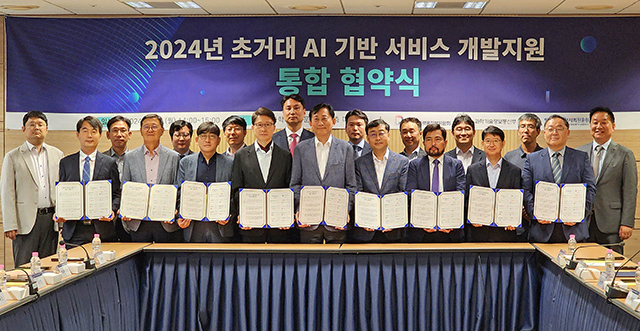
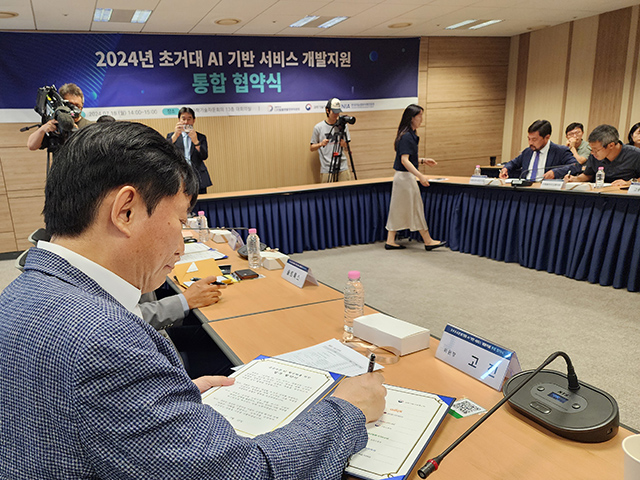
The Digital Platform Government Committee and the Ministry of Science and ICT held an 'Integrated Agreement Ceremony for Super-large AI Service Development Support' on the 15th, chaired by Ko Jin, chairman of the Digital Platform Government Committee, with demand ministries and agencies including the Seoul Fire & Disaster Headquarters, the Ministry of Employment and Labor, the Ministry of Intellectual Property, the Rural Development Administration (RDA), the Ministry of Defence, and the NRC, as well as AI supply companies, to review specific project goals and implementation plans for each of the 8 tasks.
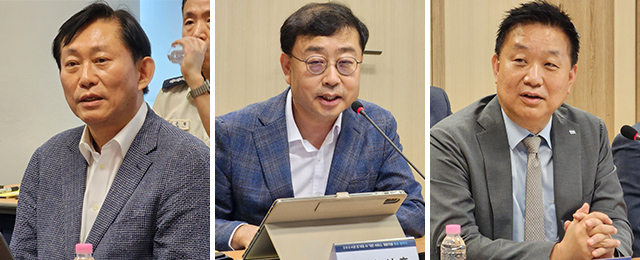
Chairman Ko Jin said, "In the war without gunfire among nations over AI, we must bet on implementing the world's first government-exclusive super-large AI model and exporting this successful model. Our ultimate goal is also export. To achieve this, various successful cases of effectively utilizing super-large AI in the public sector must be created, so I ask you to do your best to make each of the 8 tasks signed today a model case for our public sector AI services."
He added, "For this project, I have reviewed it in such detail from a practical perspective that I might be called 'Manager Ko' rather than 'Chairman Ko'. The selected 8 tasks will become known as representative AI services of Korea."
Song Sang-hun, head of the Information and Communication Policy Office at the Ministry of Science and ICT, said, "The super-large AI service development support project started last year to improve civil complaint, administrative, and legal areas in the public sector through super-large AI based on innovation demands from central ministries, local governments, public institutions, and private companies, and to contribute to solving social issues while developing specialized services."
Song Sang-hun said, "This year, building on last year's achievements, we have significantly increased the budget, and the call for proposals received 110 task demands, confirming the intense interest in super‑large AI. Among them, the eight projects selected for today's agreement ceremony were highly evaluated for their innovation, feasibility, and expected impact, and were selected after fierce competition. We look forward to the new services these projects will create."
Hwang Jong-seong, president of NIA, said, "Eight tasks were selected through fierce competition among 110. Through the selected tasks, I hope that significant learning effects will occur, dramatically improving the ability of the government and our entire industry to utilize super-large AI. Also, I expect that this agreement ceremony will achieve the outcome of sharing business know-how."
Hwang Jong-seong said, "Based on this agreement, NIA will actively promote data sharing. We will support not only the participating institutions and companies but also those who do not participate, enabling them to use the shared data for AI training."


0 Comments
No comments yet.