
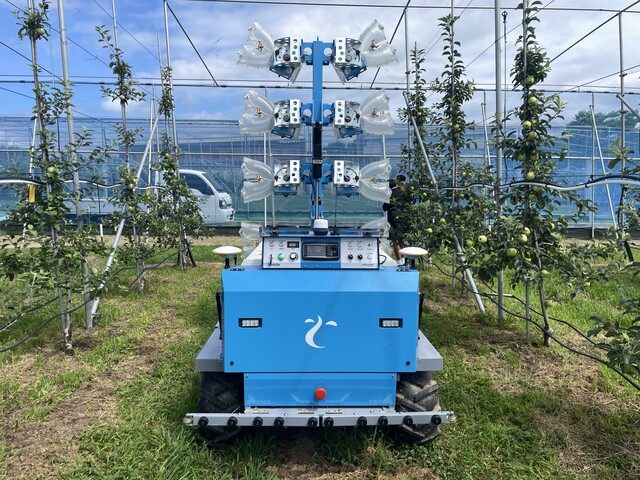
2024.07.17. The Fair Economy — The Rural Development Administration (RDA) said on the 17th that it is developing robots capable of performing farm tasks such as weeding, transport, and pest control in orchards through autonomous driving. The agency is also moving to accelerate commercialization so the robots can be rapidly adopted and spread after field trials at farms.
Rural areas are entering a super-aged society faster than cities, making mechanization essential to offset labor losses. While the use of farm machinery has increased due to an aging workforce and population decline, elderly farmers often struggle to operate machines on uneven or sloped terrain.
Additionally, many farmers struggle with the time required for essential pesticide spraying, the risk of pesticide damage, and musculoskeletal disorders caused by transporting agricultural materials.
To address these issues, the RDA has developed robots that use high-precision satellite navigation (RTK-GNSS), LiDAR laser sensors, and imaging devices to follow set paths and perform tasks such as weeding, transport, and pest control in apple, pear, and peach orchards. The agency is also improving these robots to a level suitable for real-world use to verify their effectiveness.
LiDAR is a technology that measures the distance to an object by firing laser pulses and receiving the light reflected back from the target, while also imaging the object's shape.
Stops when obstacles are present, then resumes work
Using laser sensors, weeding robots are programmed to stop within about 10 centimeters if an obstacle such as a fruit tree or worker is detected within 1.5 meters. They resume weeding once the obstacle is removed. Additionally, contact-based stopping devices have been installed on the underside of the weeding robots to ensure they halt immediately upon touching an object.
The weeding and transport robots are equipped with shock-absorbing devices such as pneumatic springs to minimize impact from the ground and flexibly adapt to uneven surfaces.
Robots shuttle between work sites and collection points to assist labor
In collaboration with industry partners, the RDA has improved the drive system of pest control robots from engine-powered to electric. A function was also added that allows the robot to move independently to a replenishment point to refill pesticides during spraying.
The transport robot normally follows workers to perform tasks such as moving harvested produce or agricultural tools. It is also equipped with a shuttle function that allows workers to send the robot to a designated location, such as a collection point, as needed. When a worker activates the shuttle function during harvesting, the robot moves to the pre-designated location, performs tasks such as transporting harvested produce, and then returns to the worker. This reduces the time workers spend stopping work to go to and from the collection point.
Robots autonomously replenish pesticides for each other
The weeding robot has space on top to double as a transport robot for carrying loads.
For transport robots, the RDA plans to add a function to transfer pesticide liquid to waypoints for use by pest control robots in coordinated operations. This technology involves the transport robot loading pesticide liquid and departing when it receives an alert that a pest control robot is running low on chemicals, allowing it to replenish the other robot along its path. Adding this feature will reduce the time and battery consumption required for pest control robots to travel for refills, thereby improving work efficiency.
To commercialize agricultural robots and verify their benefits in terms of productivity and safety, the RDA has been running a field demonstration support project for agricultural robots over five years, from last year through 2027.
Through this project, multiple and diverse robots will be deployed across the entire cultivation process, including transplanting, weeding, pest control, and harvesting, based on hubs in major production areas. Currently, robots related to digital automation, robotic farm work, pest and disease monitoring, and water stress management are being deployed and verified in Hamyang (onions), Dangjin (rice), Geochang (apples), Okcheon (peaches), Yeoncheon (soybeans), and Gimje (wheat). Based on the results, the agency plans to enable unmanned farm work not only in orchards but also in food crops and vegetables.
Additionally, starting in 2025, the agency will implement a pilot distribution project for new technologies to supplement and improve agricultural robot capabilities. The weeding robot will be applied at seven sites, and the transport robot at five sites. The electrified pest control robot will undergo field demonstration research in 2025 and be deployed at three sites in 2026. To secure core technology, industrial property rights for each robot have already been secured.
The agency is also promoting inter-agency cooperation to expand the use of agricultural robots to other fields. In May, it signed a business agreement with K-water to deploy weeding robots for trial use in managing the extensive green areas around water purification plants managed by K-water.


0 Comments
No comments yet.