
2024.07.23. The Fair Economy — The government will draw up job support measures for the construction industry, which is experiencing a decline in available work, and will consider designating it a special employment support sector if the drop in employment worsens.
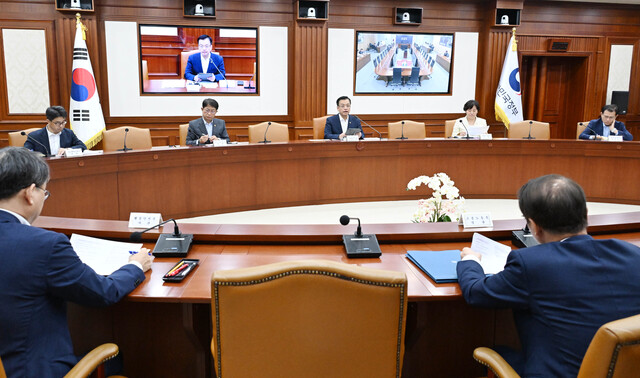
The Ministry of Economy and Finance said that Deputy Prime Minister and Minister of Economy and Finance Choi Sang-mok presided over a meeting of economy-related ministers on the 23rd at the government complex in Seoul's Jongno District and discussed these matters.
According to the ministry, the meeting covered: recent employment trends and policy tasks; measures to promote senior residences; measures to promote overseas investment and development projects; ways to improve public institutions' citizen-facing services in the second half of 2024; and the implementation results of swift budget execution in the first half of 2024.
Deputy Prime Minister Choi Sang-mok expressed deep condolences to citizens affected by recent unprecedented heavy rainfall and announced that all available resources, including disaster and emergency relief funds, will be mobilized to swiftly support the recovery of daily life for residents in the affected areas. He also urged all ministries to actively pursue "proactive measures" to protect vulnerable groups, manage energy supply and demand, and prevent industrial accidents, given the high likelihood that a heatwave will follow immediately after the rainy season ends.
He said that while July consumer prices may see a temporary rebound due to abnormal weather and base effects, the overall trend of price stabilization is expected to continue from August onward as conditions, including the supply and demand of agricultural products, improve. The government, without loosening its vigilance, plans to release more than 300 tons of cabbage and radish reserves per day in July to stabilize agricultural supply and demand, while also ensuring full support for replanting flooded crops and swift disaster recovery.
Deputy Prime Minister Choi Sang-mok also said all ministries would work together on detailed policy responses to stabilize employment for vulnerable groups, which, along with prices, is most critical to people's livelihoods. In August, the government plans to draw up support measures for construction industry jobs, which are facing growing difficulties due to a decline in available work, and will consider designating the sector for special employment support if the employment decline deepens. In addition, to support employment-vulnerable groups, the government will swiftly execute 4.6 trillion won in the second-half job budget and, through changes to its fund operation plan, expand the number of beneficiaries of programs such as regional employment promotion subsidies and living stabilization funds for low-income workers by more than 50,000 people. The government also plans to redesign the integrated employment tax credit to strengthen support for companies that increase employment, and to keep expanding infrastructure for active labor market policies, including piloting, from August, a "youth employment all-care platform" that proactively identifies and provides services to unemployed young people.
Deputy Prime Minister Choi said the government would execute its fiscal budget swiftly and without disruption to stabilize people's livelihoods. Having swiftly executed about 400 trillion won — 63% of this year's annual plan and an increase of 22 trillion won over the previous year — in the first half, he said the government would keep up smooth execution in the second half and do everything it can to boost domestic demand.
The government also plans to actively pursue livelihood-related institutional improvements that people can feel in their daily lives. First, it will introduce for-sale silver towns in population-declining regions and supply 3,000 units of welfare housing for low-income senior citizens every year, actively expanding the supply of "senior residences" that combine elderly-friendly living spaces with housekeeping, health and leisure services. In addition, starting this year, the government will allow online applications for the College Scholastic Ability Test and bank transfer payment of exam fees, and will expand the amount eligible for reimbursement support for mistaken online money transfers from the current 50 million won to 100 million won, the limit for a single transfer, among other improvements to 22 public institution services closely related to people's daily lives.


0 Comments
No comments yet.