
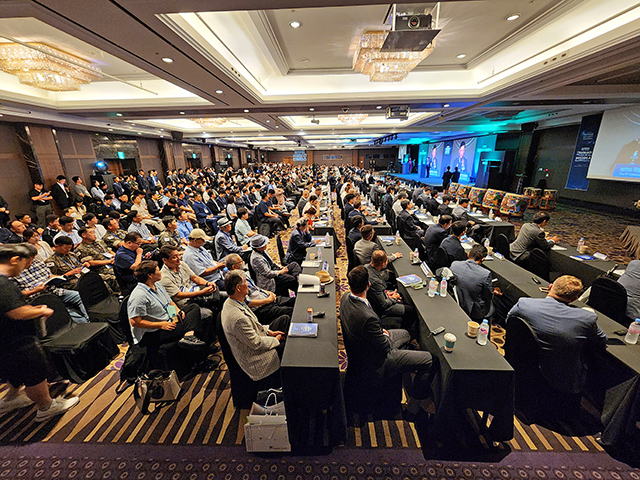
2024.07.24. The Fair Economy — The battlefield domain is expanding beyond the traditional physical realm into cyberspace and the cognitive domain. Experts from a wide range of defense-related fields gathered together to explore ways of protecting citizens' lives and property in response to these changes in the battlefield environment.
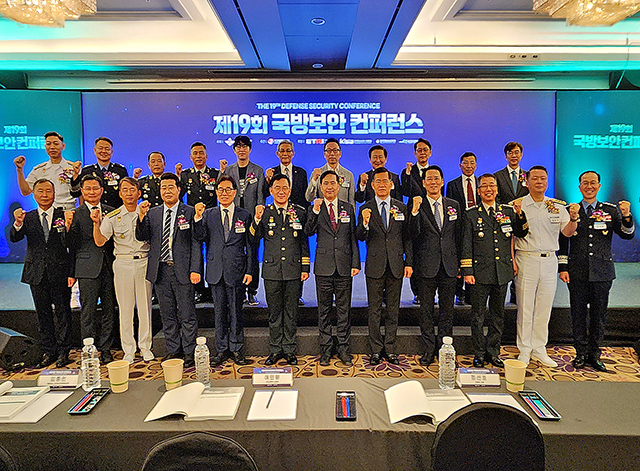
The Ministry of National Defense held the 19th Defense Security Conference on the 24th at The-K Hotel Seoul in Seocho-gu, Seoul.
The Defense Security Conference has been held annually since 2003. This year's event, themed "The Role of Defense Security in the New Domain Era," featured a keynote speech, special lectures, a security product exhibition, a presentation of papers from the Defense and Security journal, session presentations (AI security, communications security, and tech convergence), and a panel discussion on the Korea Defense Cyber Security Risk Management Framework (K-RMF).
Lt. Gen. Yeo In-hyeong, commander of the Defense Counterintelligence Command, said in his opening remarks, "Defense security is entering a new domain era, representing a new domain and a new battlefield environment. The battlefield is expanding across land, sea, air, space, cyberspace, and even the cognitive domain within the human mind. We need to secure a strategic advantage in these emerging security domains, and that requires innovative technology development alongside close cooperation among the public and private sectors, the military, and academia. At this event, we have established a new K-RMF session to create a forum for communication and cooperation through panel discussion. The Defense Counterintelligence Command will play a leading role in helping our military effectively apply advanced science and technology to the field of defense security."
Defense Minister Shin Won-sik, in congratulatory remarks read on his behalf by Vice Minister of National Defense Kim Seon-ho, said, "Amid today's rapid changes, it is important to proactively prepare countermeasures against increasingly advanced, multidomain security threats. The views presented at this conference will be of great help in advancing defense security."
In his keynote speech, Lim Jong-in, special cyber advisor to the presidential office, emphasized, "As Russia and North Korea draw closer together, North Korea's cyber capabilities are likely to strengthen. Moreover, as the digital Cold War deepens, a variety of cyber threats are expected, making it necessary to respond by building cyber resilience." Cyber resilience refers to the ability and technology to keep systems and services running even in the face of cyberattacks, natural disasters, or economic downturns.
He went on to stress the need for international cooperation, saying, "Through 'Digital Solidarity' with the United States and other allies, we must respond to cyber threats, and cooperation is essential in developing new technologies such as AI and quantum computing and in countering security threats."
Ha Jeong-u, head of Naver's Cloud Center, then gave a special lecture arguing that a defense cloud and AI transformation must take place, and that operations need to move toward zero trust and quickly recoverable systems. He stressed the importance of "sovereign AI," saying, "A global sovereign AI alliance is Korea's opportunity in the era of generative AI." Sovereign AI is a term combining "sovereign," meaning self-reliant and independent, with "AI," referring to artificial intelligence capabilities that a country or company builds independently using its own infrastructure and data, or to AI built in that way.
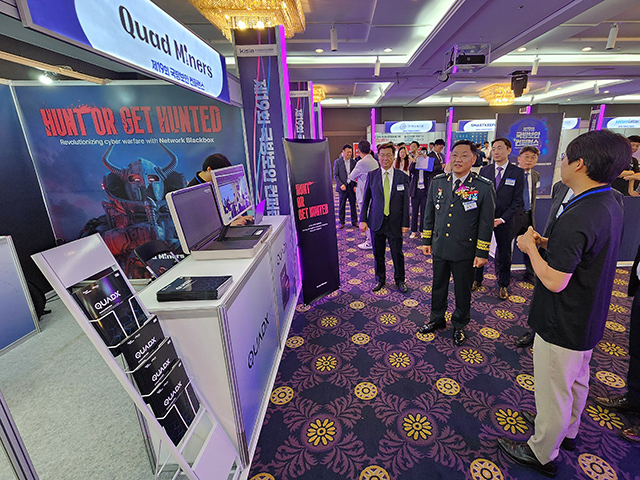
At the accompanying security product exhibition held the same day, more than 20 companies and institutions took part, presenting technologies and solutions set to lead next-generation security industries — including quantum security, generative AI, and cloud security — across a total of 28 booths. Kisia, which organized the exhibition, also ran a stamp tour event for visitors.
Participating companies and institutions include the Defense Security Institute, Nurilab, SECUI Corp., Secureletter, CTILab, AhnLab, NNSP, SSR, SSNC, SGA Solutions, Scubei, AXGate, LSWARE, Innotium, Genians, Smartkeeper, Kornic Glory, Quad Miners, Crinity, and the Electronics and Telecommunications Research Institute (ETRI), among others.
Cho Yeong-cheol, chairman of Kisia, said, "In this new domain era of increasingly sophisticated international cyber security threats, K-security is gaining importance alongside K-defense. Against this backdrop, I believe it is meaningful that we are holding the only domestic exhibition dedicated to defense security products. We will continue to actively support the Defense Security Conference's product exhibition so that it can establish itself as a leading exhibition driving the evolving field of defense security."


0 Comments
No comments yet.