
2024.08.12. The Fair Economy — It was suggested that achieving trustworthy artificial intelligence (AI) first requires securing "transparency" — the ability to explain and track AI decision-making. There were also calls for domestic AI companies to understand relevant regulations so as not to suffer disadvantages from violations, as major countries such as the United States and the European Union (EU) are establishing regulations that require AI transparency.
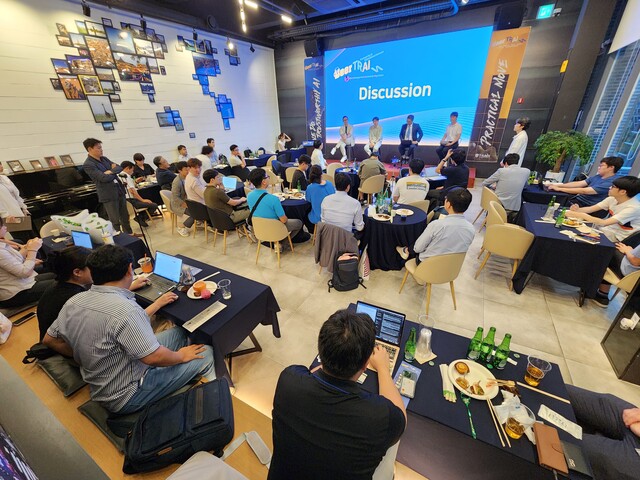
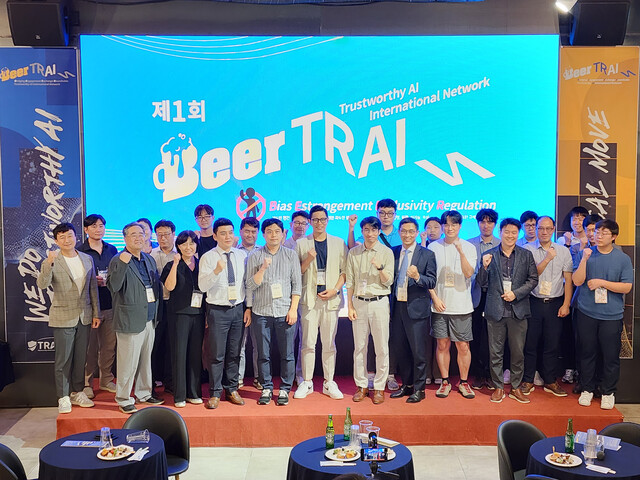
The Trustworthy AI International Network, TRAIN, recently held the '1st BEER TRAIN' event at Entrebl in Gangnam-gu, Seoul, under the theme of 'AI Reliability: Everything About Securing the First Transparency.'
The event shared the concept of securing "transparency," which is crucial in building AI systems, how transparency can be achieved in the field of AI technology development, and recent trends in related laws, international standards, and overseas cases.
Park Ji-hwan, CEO of ThinkforBL and head of the TRAIN promotion team, said in his welcoming remarks, "BEER carries the meaning that we must empty out bias toward AI, excessive distrust, exclusive competition, and excessive regulation. Negative issues surrounding AI arise from a lack of verification of AI trustworthiness, and this is an area that will require much attention going forward."

Next, attorney Ko In-seon of the AI Response Team at Law Firm Won gave a presentation on the theme "What Is the AI Transparency Required by Law?"
Lawyer Ko In-seon emphasized, "The core of AI transparency is traceability and explainability." This means that the basis on which AI made decisions must be explained, and the decision-making process must be traceable. 'Explainable Artificial Intelligence (XAI)' is drawing attention as a concept that can implement AI transparency.
He explained the trends in the AI executive order of the U.S. Biden administration and the European Union (EU)’s AI Act, which is regarded as the world’s first AI law, saying, “The EU is warning of strong sanctions, including fines of up to €35 million (about 50 billion won) or up to 7% of the previous year’s global revenue for companies that violate the AI Act’s requirements. Therefore, it is essential for domestic AI technology and solution developers to comply with the legal regulations of the United States and the EU when expanding into those markets.”
Ahn Seon-ho, head of the AI team at KTL, gave a presentation on the theme "How Should Transparency Be Addressed from a Technical Perspective?"
Ahn Seon-ho, who is also a professional member of SC42, which handles AI-related standards at the ISO/IEC JTC1/SC42, noted that various international standards in the AI field are being actively established, and that these international standards treat the verification and implementation of AI transparency as important.
Various international AI standards require, for AI services and systems, the disclosure or implementation of information on items such as: the identity and contact information of the provider and authorized representative; the characteristics, functions, and performance limitations of the AI system; the intended purpose; the level of test and verification accuracy, robustness, and cybersecurity metrics and expected levels (situations that may affect the expected levels); situations that could cause risk under misuse conditions; information to interpret and appropriately use the AI system’s output; technical measures designed to facilitate output interpretation; maintenance and management measures including required hardware resources, expected lifespan, and updates; and logs that can be collected, stored, and interpreted.
Cheon Seon-il, manager of ThinkforBL's AI Trustworthiness Technology Team, gave a presentation on cases from major countries such as Singapore, the EU, and the United States, under the theme "What If AI Transparency Differs by Country? What Do Others Do?"
Cheon said that Singapore has established a nonprofit foundation as a technical consultative body for ethical AI development, and that it provides an AI governance testing framework and a software toolkit. He added that the toolkit includes checklist items for verifying transparency.
He also explained that Belgium, an EU member state, has formed and is operating a research consortium involving three universities as part of its Flanders AI Plan.
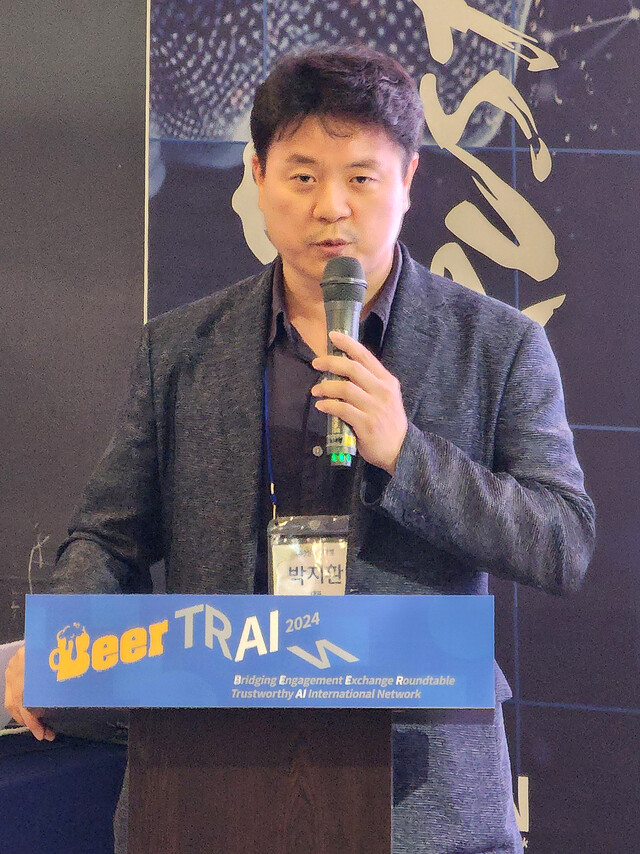
Team leader Park Ji-hwan stressed, "The non-technical, ethical aspects related to AI have already been publicly discussed through numerous media reports, and appropriate compliance measures are being established accordingly. Now is the time to look at the technical aspects rather than the ethical ones. Major countries around the world are enacting legislation that technically addresses the potential for ethical problems to arise. Korea, too, should not remain stuck on the ethical and moral aspects of AI, but should move forward with technology development and related institutional arrangements to secure AI transparency."
Park Ji-hwan stressed that AI bias problems that have actually occurred in Korea — such as the Iruda chatbot's incident of making hateful remarks about women and sexual minorities — were not caused by malicious intent on the part of AI technology and system developers, but by a lack of technology for selecting trustworthy data and applying it to training, and a lack of capability to manage systems so that they do not develop bias. He pointed out that the longer Korea delays in establishing systems and technology to secure AI transparency, the more inevitable it becomes that a second Iruda incident will occur.


0 Comments
No comments yet.