
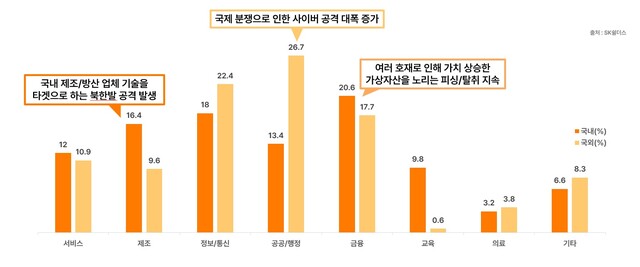
2024.07.03. The Fair Economy — An analysis of intrusion incidents by industry in South Korea found that the financial sector accounted for the highest share at 20.6%.
SK Shieldus (CEO Hong Won-pyo) recently announced that it held a media seminar analyzing major security trends for the first half of 2024 and presenting AI LLM security response strategies.
The presentation was based on an analysis by Sk Shieldus' EQST (Experts, Qualified Security Team), the country's largest group of white-hacker experts, drawing on hacking incidents they directly experienced and research results from the first half of the year.
In particular, the seminar demonstrated three types of attacks exploiting vulnerabilities in AI large language models (LLMs), which have recently drawn attention, and presented security measures.
EQST noted that virtual asset theft and deepfake hacking attacks were prominent topics in the first half of 2024. In January, a zero-day vulnerability was discovered in the Ivanti VPN solution, widely used globally, causing damage across various industries. In February, it was revealed that Volt Typhoon, a group believed to be supported by the Chinese government, had attacked the internal networks of major U.S. infrastructure. There was also a case where a company sent 34 billion won (about $25 million) after being deceived by a deepfake video conference. In March, a backdoor was found in the open-source XZ Utils. In April, malicious email attacks occurred using malicious scripts written by an LLM, and in May, a blockchain-based game platform was hacked, resulting in the theft of 30 billion won (about $22 million) worth of virtual assets.
Most attacks target domestic financial sector
According to EQST's statistics on security incidents by industry, attacks targeting the financial sector in Korea accounted for the highest proportion at 20.6%. With issues such as the approval of Bitcoin ETFs raising the value of cryptocurrencies, hacking attacks targeting them continued. Overseas, attacks on government and public institutions accounted for the largest share at 26.7%, driven by international conflicts involving Russia and Israel.
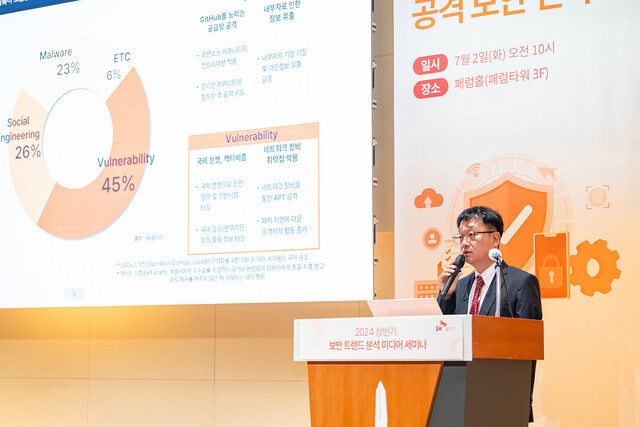
By type, vulnerability attacks were the most common at 45%, attributed to advanced persistent threat (APT) attacks via network equipment such as VPNs and routers. Social engineering attacks, which exploit human psychology to steal confidential information, followed at 26%.
In this first half, attacks exploiting newly discovered vulnerabilities in network equipment proliferated, showing an increase of more than double compared to the same period last year. Additionally, ransomware attacks that exploit 1‑day vulnerabilities—taking advantage of unpatched systems despite security patches being released—or that use legitimate tools have occurred. Recently, ransomware attackers have been targeting remote monitoring and management (RMM) systems or employing living‑off‑the‑land (LotL) techniques to evade detection by security solutions, requiring heightened vigilance.
RMM (Remote Monitoring and Management) refers to technologies and services for remotely monitoring and managing IT systems and networks, while LotL (Living off the Land) is a technique that minimizes malware use and maliciously exploits legitimate programs installed on servers.
Three types of vulnerabilities that can arise in generative AI services
EQST presented research findings on security threats that AI could bring as generative AI rapidly advances. In particular, EQST analyzed the 10 vulnerabilities that can occur in AI LLM services as published by the nonprofit OWASP (Open Web Application Security Project) and demonstrated three of the highest-risk ones.
First, it demonstrated 'prompt injection.' This vulnerability allows malicious questions to bypass the instructions or policies applied within an AI service, eliciting answers beyond its intended purpose. It can be exploited for malware creation, drug manufacturing, phishing attacks, and more.
Next, it demonstrated the 'unsafe output handling' vulnerability. This occurs when the system fails to properly process output generated by an LLM, and it is highly dangerous because it can lead to secondary attacks. For example, if an attacker asks a chatbot a question containing a request to execute remote access code, and the chatbot executes the code, the attacker could gain access to the AI LLM operating server and steal sensitive information.
Finally, EQST analyzed the 'sensitive information disclosure' vulnerability, which can arise from inadequate filtering of personal information or poor application permission management, and demonstrated an attack that steals database information. If sensitive information filtering is insufficient when training LLM models, the LLM may output learned sensitive information in its responses, so additional measures such as pseudonymizing training data or validating data are needed.
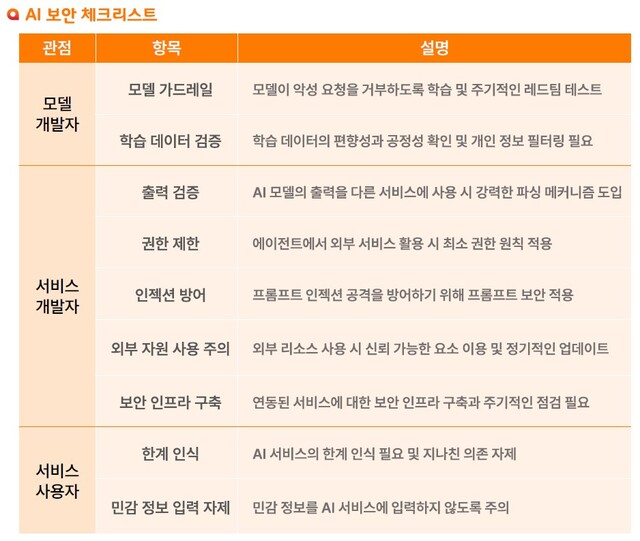
In addition, EQST analyzed vulnerabilities that frequently occur in LLM applications, dividing them into LLM service operation, development, and model development and dependency stages, and explained security measures for each. Recommended measures include adopting 'prompt security solutions' when using LLMs or considering 'data sanitization solutions.' EQST also provides an AI service security checklist to help check security threats when developing and using AI services.
'Providing customized services in line with the latest security trends'
SK Shieldus is providing customized services ranging from AI penetration testing to connected security services, keeping pace with the rapidly growing AI service landscape. Since LLM infrastructure—including servers, model repositories, and plugins—is far more complex than typical web server configurations, building security systems tailored to customer environments is essential.
Based on its experience conducting vulnerability assessments and penetration testing across various industries to enhance security levels, SK Shieldus plans to offer services for establishing zero-trust environments and operational systems specialized for AI infrastructure. It also presents strategies such as helping companies manage security histories using software bills of materials (SBOM).
Kim Byeong-mu, vice president and head of SK Shieldus's information security business division, said, "As AI technology adoption spreads across all industries, security threats targeting it are becoming a reality, requiring systematic preparation. SK Shieldus will continue to proactively publish research findings aligned with changing security trends and present security strategies for the generative AI era."
Meanwhile, the report on first-half 2024 security trends and security strategies for safe AI utilization analyzed by EQST is available for free download on Sk Shieldus' official website (www.skshieldus.com).


0 Comments
No comments yet.