
2024.07.18. The Fair Economy — With large-scale new towns planned for the eastern and southern parts of the capital area, each with a planned population of about 260,000 and 220,000 respectively, opinions have emerged that a new metropolitan road network is needed for these regions.
The Gyeonggi Research Institute said on the 18th that it has published a report titled "Third-generation New Town Regional Transportation Measures: Zonal Planning Is Needed!" containing these findings.
According to the report, as part of the housing supply expansion measures announced since 2018, new town and public housing district development projects are underway in the eastern and southern parts of the capital area.
All five development projects in the eastern metropolitan area exceed the 500,000-square-meter threshold for formulating regional transportation improvement measures. In particular, Wangsuk Districts 1 and 2 are the largest among third-generation new towns.
The four development projects in the southern metropolitan area also all exceed the 500,000-square-meter standard for regional transportation improvement measures, with the Uiwang-Gunpo-Ansan district comparable in scale to a new town. While the four public housing districts in the south are not immediately adjacent to those in the east, the distance between their boundaries is only a few kilometers.
Accordingly, from the perspective of the metropolitan transportation system, the new towns and public housing districts in the eastern and southern capital areas can be viewed as one giant new town.
Analysis suggests that traffic demand generated by individual districts in the eastern and southern metropolitan areas must be handled using a shared regional transportation network connecting Seoul with each area.
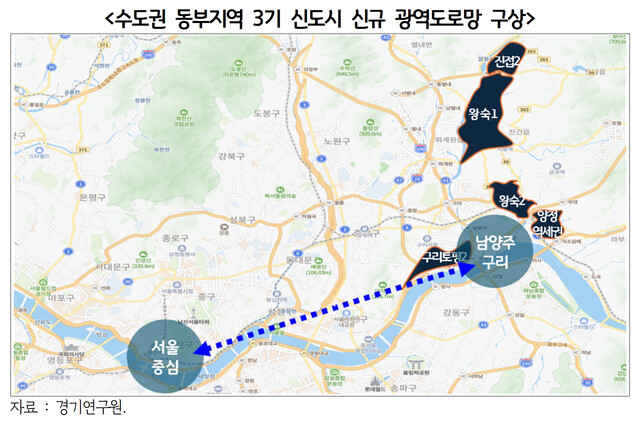
Of the five districts in the eastern capital area, four, excluding the Guri Topyeong 2 district, have completed the establishment of metropolitan transportation improvement measures.
In the railway sector, plans include the Byeollae Line, which can handle metropolitan transportation demand, the urban railway project between Gangdong, Hanam, and Namyangju, and the establishment of new stations on the Gyeongui-Jungang Line, Jinjeop Line, and Gyeongchun Line.
In contrast, while a plan for a connecting road network linking arterial roads adjacent to the districts was presented in the road sector, the regional road network connecting different cities and provinces remains insufficient.
Consequently, traffic congestion on arterial roads in the eastern capital area is expected to be inevitable.
Considering land use and topography in the eastern metropolitan area comprehensively, constructing a new arterial road along the Gyeongchun axis to connect Seoul and Gyeonggi Province was analyzed as an alternative.
Given various constraints, including the need to pass through bottleneck sections of the Seoul city boundary, it is pointed out that new road construction, such as underground roads, is necessary.
However, considering the scale of construction costs and the scope of benefits for underground roads, it was found unrealistic to proceed with them as a regional transportation improvement project for a single district.
Despite these individual metropolitan transportation improvement measures, it is analyzed that traffic congestion in the eastern capital area will worsen in the future compared to the present.
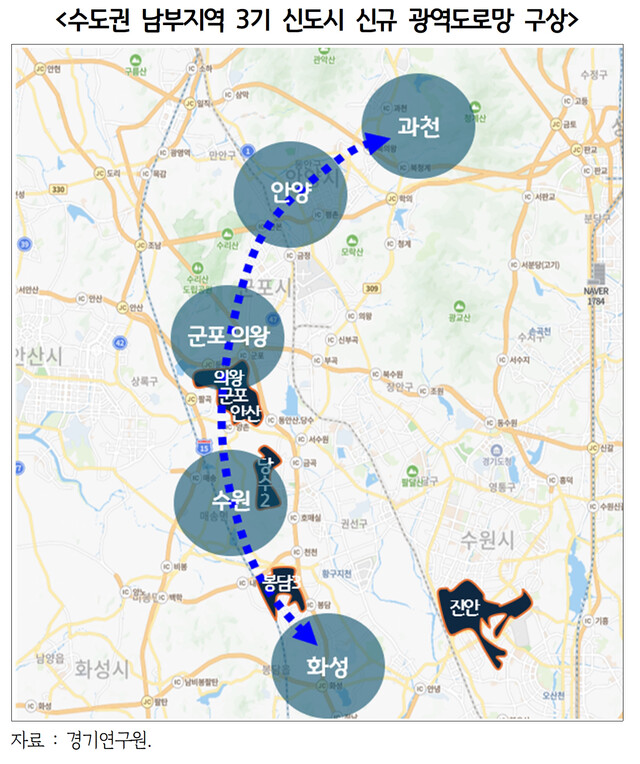
The four districts in the southern region are currently in the process of establishing metropolitan transportation improvement measures, but difficulties are expected in expanding metropolitan infrastructure as measures are established on an individual district basis.
In the railway sector, it is analyzed that the existing Line 1, Line 4, and Suin-Bundang Line, as well as the future Shinbundang Line (Homaesil extension), GTX-A, and GTX-C, will be linked and utilized.
In the road sector, plans are likely to focus on a connecting road network linking existing arterial roads adjacent to the districts.
Accordingly, the institute proposed zonal regional transportation improvement measures as a strategy for building a regional transportation network. These include introducing zonal regional transportation improvement measures suitable for third-generation new towns; proposing ultra-large-scale infrastructure expansion plans that are impossible under individual project-based measures through zonal planning; and establishing a system to formulate and review integrated zonal regional transportation improvement measures.
In addition, for the timely implementation of new town regional traffic improvement measures, the institute proposed a comprehensive pre-feasibility study approach that includes: ▲ an integrated evaluation considering the prolonged duration and network effects of conducting separate pre-feasibility studies for each regional traffic improvement project; ▲ a unified pre-feasibility study to ensure timely implementation by accounting for the interlinkage of multiple regional traffic improvement measures associated with new town development; and the construction of a new regional road network to prevent worsening traffic congestion due to the development of the 3rd-phase new towns in the eastern and southern parts of the Seoul Capital Area.
Kim Byeong-gwan, a research fellow at the Gyeonggi Research Institute, emphasized, "With insufficient regional transportation improvement measures, traffic inconvenience is expected to worsen not only for existing residents but also for those moving in. It is necessary to formulate zonal regional transportation improvement measures, conduct batch preliminary feasibility studies for these measures, and build a new regional road network in the eastern and southern metropolitan areas."


0 Comments
No comments yet.