
2024.07.25. The Fair Economy — A consensus is forming that regulatory reform removing obstacles to innovation and risk-taking by digital companies is essential to strengthening the competitiveness of Korea's digital industry.
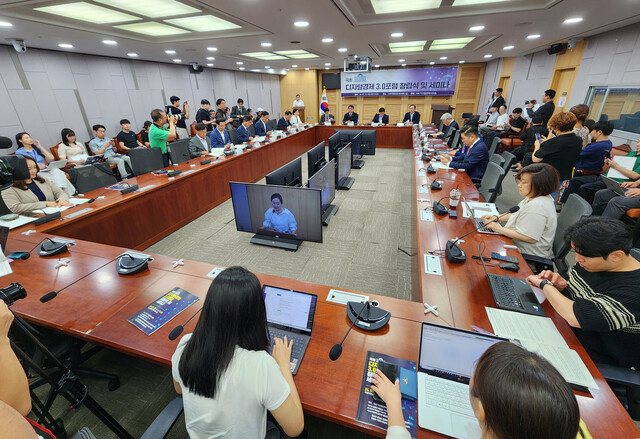
Rep. Lee Seong-gwon of the National Assembly's Administrative and Safety Committee held the inaugural ceremony and seminar of the 'National Assembly Digital Economy 3.0 Forum' on the 25th at the first seminar room of the National Assembly Members' Hall.
The forum is a parliamentary research group co-chaired by Reps. Lee Seong-gwon and Kim Jong-min.
At the event, participants held the inauguration ceremony marking the forum's launch along with a commemorative seminar, exploring the forum's future direction and research methods.
At the seminar, Park Seong-ho, chairman of K-INTERNET, and Koo Tae-eon, an attorney and vice chairman of the Korea Startup Forum, emphasized that regulatory reform must come first for the development of Korea's domestic digital industry.

Chairman Park Seong-ho gave the first presentation on the topic "Why Digital Economy 3.0?"
He analyzed that the negative view held by the government and the National Assembly toward digital platforms is the cause of excessive regulation, saying, "When K-INTERNET hosts events, we try to invite and communicate with government agencies such as the Fair Trade Commission. The Fair Trade Commission, however, does not invite the association when it holds its own events. It made me think that the government regards the industry not as a partner for communication but as a target of regulation." He added, "There are cases where regulations imposed on domestic companies cannot be applied to foreign companies," pointing to the reality of so-called "half-baked regulation" that discriminates only against domestic firms.
Chairman Park Seong-ho said, "The most regrettable situation is that companies which should be fiercely pursuing survival strategies are instead spending their time responding to regulations," stressing that fundamentally changing perceptions of digital platforms and the companies that operate them is necessary to solve this problem.
He argued, "Amendments are needed to abolish existing regulations. Existing laws should also be evaluated. It is time to establish a ministry that oversees digital economy policy in order to improve regulation. There should be national support to nurture flagship artificial intelligence (AI) companies."
Next, attorney Koo Tae-eon, vice chairman of the Korea Startup Forum, gave a presentation on the topic "Measures to Foster Digital-Based Startups."
He also strongly criticized that, as a result of the government's previous regulation‑focused policies, the domestic digital economy industry has now reached a state of near‑total devastation.
Vice Chairman Koo Tae-eon sharply criticized in front of the attending lawmakers, saying, "In the early stages of an industry, 'guideline'-type regulations may be necessary for the sound development of the industry. However, the current regulation-focused laws and systems are the result of the National Assembly and the government yielding to the backlash of traditional industries." He also assessed that as a result of such regulations prevailing, the domestic industry has no choice but to rely on foreign technology, weakening competitiveness and accelerating the extinction of the industry itself.
He introduced the four major fields of innovative startups based on Digital Economy 3.0 — AI and machine learning, blockchain and crypto‑asset technology, big data and data analysis, and metaverse and extended reality (XR) — and presented opinions on sector‑specific development measures.
Vice Chairman Koo Tae-eon proposed allowing rapid experimentation and shifting to ex‑post regulation to foster AI startups. Specifically, he said it is necessary to reasonably amend the Personal Information Protection Act, permit text and data mining (TDM) under the Copyright Act, and grant partial regulatory exemptions to AI startups below a certain scale.
As measures to foster startups in the blockchain and crypto-asset sector, he argued for establishing a "Digital Asset Agency" to oversee digital asset regulation—thereby resolving the problem of multiple ministries competitively creating new regulations—and for introducing electronic finance based on public distributed ledgers into financial services.
To nurture big data and data analysis startups, he proposed that big data processing be deemed lawful by default and that the full opening of public data be mandated under appropriate anonymization measures.
As measures to foster the metaverse and XR fields, he suggested revising government security regulations to allow the use of private metaverse services in public institution meetings, and providing subsidies or tax benefits to companies using the metaverse to support pregnant women and workers with childcare responsibilities.
The inaugural ceremony was attended by co-chairs Reps. Lee Seong-gwon (People Power Party) and Kim Jong-min (New Future), research director Rep. Cho Seung-hwan (People Power Party), regular members Reps. Kim Hui-jeong (People Power Party), Park Su-hyeon (Democratic Party of Korea) and Jung Yeon-uk (People Power Party), and associate members Reps. Kim Yeong-bae (Democratic Party of Korea), Seo Cheon-ho (People Power Party) and Seo Wang-jin (Rebuilding Korea Party). In addition, Han Dong-hun, leader of the People Power Party, attended the ceremony and delivered a congratulatory speech.
Rep. Lee Seong-gwon said, "One of the significant changes between the National Assembly in 2004 and the National Assembly 20 years later is that it operates unilaterally without consultation processes," adding, "Regardless of ruling or opposition parties, political circles need responsibility and reflection, and to solve this, we must all work together."
He continued, "Another is the sea-change transformation into the digital era. To lead the super-gap era and strengthen the competitiveness of the digital industry, legislative activity is important, and regulatory reform that removes barriers to the development of the digital industry is key."
Han Dong-hun, leader of the People Power Party, stated, "There is much interest in the development of AI technology, and I feel a sense of crisis that we might fall behind or miss the timing and drop to the second tier. I will think about what politics should do to prepare for the AI era."


0 Comments
No comments yet.