
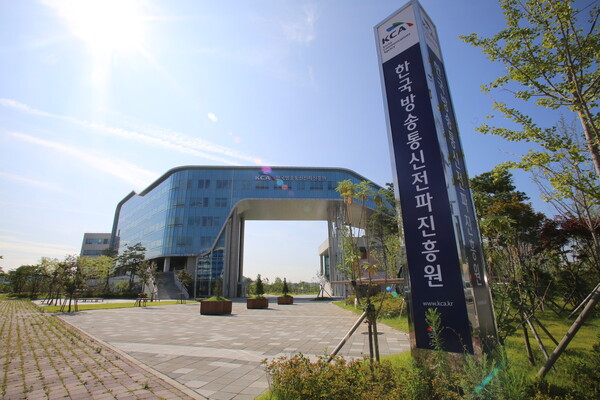
2024.08.06. The Fair Economy — The KOREA COMMUNICATIONS AGENY (KCA) has entered an "emergency management system" to respond to declining financial performance and a crisis in its internal and external management environment.
KCA is a quasi-governmental organization that carries out projects for the efficient management of radio waves and the promotion of broadcasting, telecommunications, and radio waves, as well as tasks entrusted to it by the government.
While the agency funds its operations through wireless station inspections and ICT national qualification testing projects, among others, it recorded operating losses of 3.26 billion won in 2022 and 3.034 billion won in 2023.
In response, on the 5th, KCA declared an emergency management system at its headquarters in Naju, South Jeolla Province, with all employees in attendance, and began establishing an emergency response system.
At the declaration ceremony, KCA established the "Emergency Management Committee," a dedicated body for emergency management, and set up a system to regularly review its management performance.
Detailed action items include ▲cutting its own budget spending by 20%, ▲having executives return 20% of their performance pay, ▲accelerating the sale of non-core assets, and ▲streamlining its organization and workforce. KCA also plans to strengthen policy publicity to raise public awareness of the agency, pursuing management innovation that the public can actually feel.
Following the declaration of the emergency management system, all executives decided to return 20% of their internal performance pay to create a "Social Contribution Development Fund." An official said the fund will be used for a job package program for young people preparing for independent living in the Gwangju and Jeollanam-do regions, as well as for ESG projects for underprivileged local residents.
KCA President Lee Sang-hun stressed, "From now on, we will switch KCA's operations to an emergency management system. Let us all come together as one and pool our wisdom to overcome this management crisis, so that KCA can become an organization trusted by the public and the government."
Meanwhile, following the declaration ceremony, KCA also held an integrity practice resolution rally, where all executives and employees pledged to make anti-corruption and integrity practices part of their daily work and to take the lead in building a "clean KCA" that is more trusted by the public.
The industry assessed that the reduction in facility investment by mobile carriers would negatively affect the improvement of KCA's management conditions.
An industry official said in a phone call, "Despite issues such as 5G quality, mobile carriers are reducing their facility investment to maximize profits. As a result, telecommunications construction companies responsible for building and maintaining carrier facilities, as well as KCA, which conducts radio station inspections, are inevitably affected."
There are also analyses that mobile carriers' abandonment of the 5G business using the 28GHz frequency band is not unrelated to KCA's poor business performance.
To communicate using the 28GHz frequency, base stations need to be built far more densely than existing ones. After the three major carriers—SKT, KT, and LG Uplus—abandoned their 28GHz 5G business, the government recovered the frequency.
Recently, the government also revoked the frequency allocation eligibility of Stage X, which had planned to provide 5G mobile service using the 28GHz frequency, on the grounds that it had failed to fulfill requirements set out under the Radio Waves Act and other related regulations.
The industry pointed out that the government made an unreasonable move while the technology to overcome the characteristics of the 28GHz frequency has not yet matured.
At the '2023 Korea Information and Communication Facility Society Autumn Conference' held last year, Jang Byeong-jun, a professor in the Department of Electronics Engineering at Kookmin University, explained, "Currently, base stations based on RF beamforming technology are being built and operated with the limitations of low power and low cost. Only when beamforming technology based on wireless sensing (direction finding) matures can 28GHz 5G service take root."
This suggests that, without innovative technological advances, it will be difficult for the mobile carrier industry to overcome the burden of building base stations for 28GHz 5G.
KCA has drawn up a tight budget this year, cutting it by about 15% from the previous year, but labor costs are expected to continue rising every year, and consignment income is also unlikely to increase easily. Accordingly, the industry views the improvement of KCA's management conditions as not going smoothly.


0 Comments
No comments yet.