
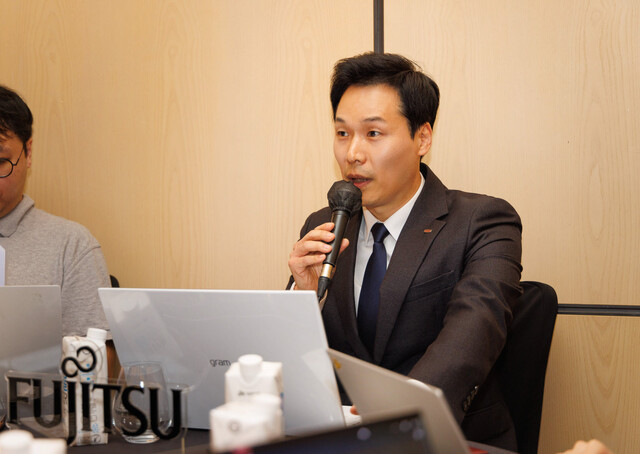
2024.08.22. The Fair Economy — Park Gyeong-ju, CEO of Fujitsu Korea Limited, held a roundtable on the 21st at the Four Seasons Hotel Seoul in Jongno-gu, Seoul, to explain the company's business strategy regarding digital transformation (DX). He explained how the company's 'palm vein' recognition technology and solutions are being utilized in DX.
CEO Park Gyeong-ju said, "Fujitsu Korea, which marks its 50th anniversary this year, supports the DX of various companies and institutions, helping customers gain a clear understanding of DX and enhance internal value. We are also preparing for the expansion of palm vein authentication and the activation of palm vein-based payments in the future."
DX can be divided into four stages… presenting precautions for each stage
At the event, CEO Park Gyeong-ju pointed out that DX evolves in stages, including ▲resource efficiency ▲internalization through convergence ▲discovery of unexpected service models ▲and linkage with social responsibility.
In the "resource efficiency" stage, he explained that companies aim to improve the efficiency of internal resources by introducing digital technologies and related solutions to respond to rapidly changing business environments.
This stage aims for digitalization, improvement of internal processes, and rapid decision-making. It involves introducing numerous solutions and systems such as cloud, Internet of Things (IoT), Big Data, artificial intelligence (AI), and robotic process automation (RPA) to establish processes and conduct evaluations and feedback on them. Park viewed this first stage not merely as introduction, but as a cycle that includes ongoing improvement, evaluation, and feedback.
He said that while organizations and companies promoting DX may interpret evaluation results in various ways, it is important to clearly understand the direction of DX adoption, whether it meets objectives, and its internal and external impact based on factual and objective evaluation and feedback.
In the 'internalization through convergence' stage, he said, already introduced solutions are combined or converged with other solutions, improved processes, and other business areas to assume generative and predictable results. This means seeking synergistic effects through mutual combination.
He explained that this is a process where various attempts and diverse idea models, ranging from individual employee tasks to internal organizational processes and external business areas within DX-promoting institutions and companies, are internalized to create results and begin to be built up and accumulated in the form of processes.
Regarding the 'discovery of unexpected service models' stage, Director Park Gyeong-ju said, "If the previous stages continue, at some point various forms of service models begin to emerge." He said this stage is when effective improvement of internal processes is achieved through mutual complementation and sharing among organizational staff. He also explained that this is when unexpected services and business models begin to be newly created through active exchanges across business areas.
In the final stage, 'linkage with social responsibility', he viewed this as the point where the organization's performance structure, such as revenue, is influenced, and where it can also have some impact on social issues or become a means of solving them.
When companies and institutions place value on the fundamental goal of fulfilling social responsibility and present corporate operations and member goals accordingly, the internalization process naturally connects with externalized social responsibility, along with DX.
For successful DX, be wary of panacea thinking and passive participation
CEO Park Gyeong-ju emphasized that for companies and institutions to reach the goal of DX, an 'evolution of awareness' must occur, including ▲the fact that DX solutions are not a magic wand that can solve everything ▲and that technology, culture, personnel, and organization must come together holistically and be proactive in change.
This means that before introducing DX solutions, it is necessary to establish detailed plans and carefully examine whether the solution is truly necessary for the company, including its internalization potential. Many companies and institutions, having skipped such preliminary procedures and imitated other organizations in pursuing DX, have wasted time and money without achieving satisfactory results.
CEO Park Gyeong-ju said, "People think about high entry barriers when considering the high value of DX solutions, but that is not the case," emphasizing that planning and feasibility review before DX must be carried out.
He also stressed that DX is not achieved merely by introducing new technologies or solutions, but requires technology, culture, people, and organization to respond organically and actively to DX.
CEO Park Gyeong-ju said, "While DX focuses on technology, its foundation is directly connected to corporate culture. People themselves must seek direction for DX and be proactive in trying different approaches. Business leaders must keep this in mind and support DX to successfully internalize it and create new service models. In fostering organizational awareness and culture for DX, the leader's will and change are most important."
Contactless biometric authentication 'palm vein' spreading
CEO Park Gyeong-ju explained how the company's palm vein authentication, a non-contact biometric authentication technology launched in 2003, functions and delivers results at each stage of DX for companies and institutions.
The palm vein solution was initially introduced in financial institutions for user authentication through staff self-authentication or for internal control in the portable branch, a mobile financial terminal device. Financial companies, having learned about the security and safety of palm vein authentication, began providing palm vein-based customer authentication services through kiosks as a means of identity verification in addition to ID cards, to offer customers a convenient financial experience.
Next, internalization was achieved by building a biometric shared network to enable the fragmented and individualized palm vein-based authentication services in the financial sector to be used more stably and conveniently through a distributed management approach. Additionally, synergies were created as airports used the palm vein solution in the "biometric airport linkage service" in collaboration with financial institutions for identity verification.
CEO Park Gyeong-ju said that unexpected service models are emerging, such as the combination of palm vein solutions with payment services. At domestic airport duty-free shops, a service model is being discovered and implemented that moves away from ID-based authentication and connects to payments using palm vein authentication. He also reported that a major retail company is exploring the development of related services, noting that introducing a payment system based on palm vein authentication in the financial sector could enable convenient and secure payments and also reduce credit card fees.
He also mentioned that palm vein authentication technology and solutions are producing effects in the ESG field. He noted that the characteristics of palm veins, which are virtually impossible to replicate, are specialized for adult authentication and payment, and thus can positively contribute to solving social issues for youth protection. He also predicted that it could positively contribute to resolving social issues such as the implementation of the revised National Health Insurance Act or the prevention of improper receipt of national pension benefits. He added that since it eliminates the need for physical plastic cards, it is eco-friendly and thus positive for realizing ESG values.


0 Comments
No comments yet.