
2024.06.04. The Fair Economy — The Ministry of Science and ICT and the Ministry of Economy and Finance announced on the 4th that the 'Innovation Plan for the Investment and Management System for Large-Scale National R&D Projects' — detailed implementation measures for the 'abolition of preliminary feasibility studies (PFS) for research and development (R&D)' announced at the 2024 National Fiscal Strategy Meeting — was finally approved at the 8th deliberative session of the Presidential Advisory Council on Science and Technology (PACST).
The PFS system was introduced in 1999 to verify the feasibility of large-scale national fiscal investments before they are made. The R&D sector has been subject to PFS since 2008.
Since 2018, the Ministry of Science and ICT has been commissioned by the Ministry of Economy and Finance to operate the R&D PFS system. Taking into account the unique nature of R&D, which requires swift responses to technological change, it has continued pursuing improvements such as reducing the weight given to economic feasibility and introducing a fast track, in order to secure flexibility and speed.
Even so, it takes an average of more than three years from planning to passing the PFS, and the gap between the PFS system and R&D — which demands speed, creativity and a willingness to take on challenges — has led researchers in the field to continuously call for a fundamental overhaul of the system.
In particular, after researchers suggested abolishing the PFS at the 6th plenary meeting of the National Science and Technology Advisory Council, the National Fiscal Strategy Meeting confirmed the policy to abolish the PFS in the R&D sector, and the necessary detailed implementation measures were reflected in this plan.
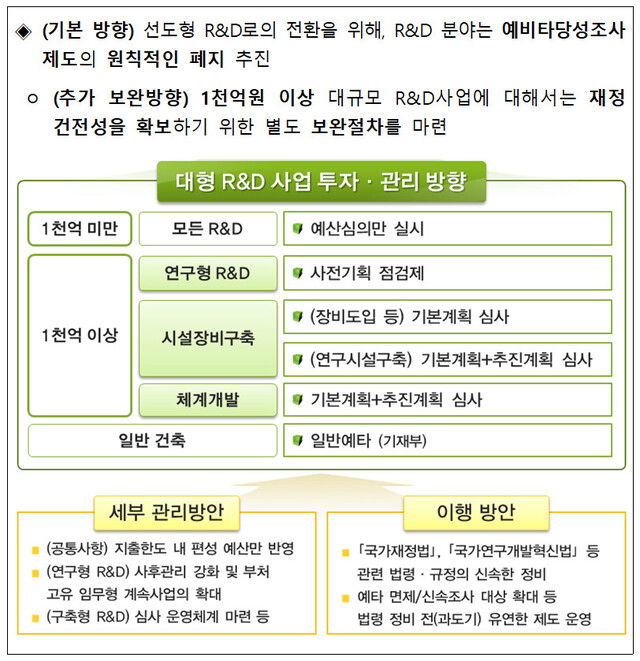
Under the approved plan, all new R&D projects under 100 billion won (about $72 million) will proceed through the standard budgeting process. This is expected to shorten the time to launch new projects worth 50 billion to 100 billion won (about $39 million to $78 million) by more than two years compared with before the PFS abolition.
For research-type R&D projects worth 100 billion won (about $71 million) or more, such as basic and source research and international joint research, an in-depth review is difficult to carry out within the short budget deliberation period. To address this, project implementation plans will be submitted in advance in October of the year before the budget request, and a preliminary expert review led mainly by private-sector experts will be conducted. Unlike the existing PFS system, this will not be a pass/fail decision on new R&D projects but will instead aim to improve the completeness of project planning. The results of the expert review will be notified to each ministry in March of the following year, and each ministry will use them to supplement its planning when requesting the next year's budget.
For procurement of research equipment or system development projects worth 100 billion won (about $71 million) or more, a customized screening system will be introduced, applying differentiated procedures depending on project type and management difficulty, with a focus on ensuring solid project implementation and fiscal soundness.
For simple research equipment introduction projects that do not require separate technology development and have low project management difficulty, a basic project plan will be established focusing on necessity, utilization plan, and promotion strategy, and reviewed to quickly decide whether to proceed.
For large research facility construction projects such as particle accelerators, and system development projects such as satellites and launch vehicles — which involve technology development and a high degree of management difficulty — a two-stage review will be carried out: a 'basic plan review,' which examines the 'necessity of implementation' to decide whether to 'build' the facility, and an 'implementation plan review,' which examines the degree of project preparedness to decide on 'project launch' and the 'scale of budget investment.' In addition, to reduce the risk of large-scale budget investment, preliminary technology development needed for facility construction or system development may be separately pursued in advance as a stand-alone research-type R&D project before the basic plan is established.
The results of the expert review or implementation plan review will be notified in March, before the budget request. Each ministry will be required to autonomously adjust all of its R&D projects within its expenditure ceiling according to its own priorities by the end of April when requesting the following year's budget, which is expected to enhance fiscal soundness and strengthen each ministry's accountability. In addition, the soundness of project implementation will continue to be reviewed and managed each year during the budget deliberation stages of the Innovation Headquarters and the Ministry of Economy and Finance. Projects found to have problems during this process will have their continuation and appropriate scale reviewed through special evaluations, and ex-post management will be strengthened, including terminating problematic projects.
Lee Jong-ho, Minister of Science and ICT, said, "For this abolition of R&D PFS to actually be applied, the 'National Finance Act' must first be revised, so I ask the National Assembly to provide bipartisan support so that Korea does not fall behind in global technology competition. Until the law is revised, we will work to ensure that R&D projects that must be pursued as a matter of national policy can move forward swiftly, including through a 'Fast Track' that is shorter than the existing PFS, and by expanding the scope of PFS exemptions for innovative and challenge-type R&D projects."


0 Comments
No comments yet.