
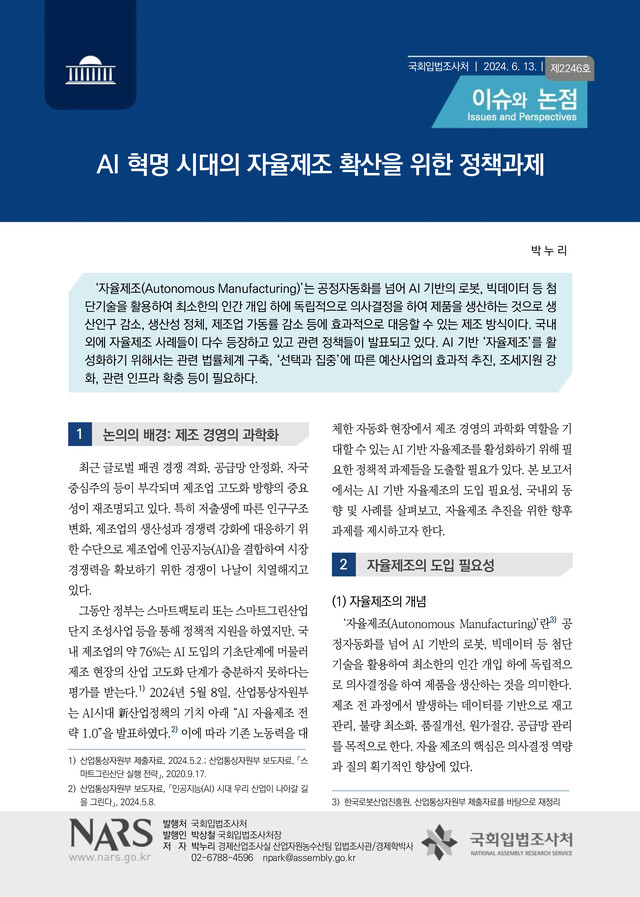
2024.06.14. The Fair Economy — The NATIONAL ASSEMBLY RESEARCH SERVICE released a report titled "Policy Tasks for the Diffusion of Autonomous Manufacturing in the Age of the AI Revolution" under its "Issues and Perspectives" series on the 13th.
According to the report, intensifying global hegemonic competition, efforts to stabilize supply chains, and growing nationalism have renewed attention to the importance of advancing the manufacturing sector. In particular, competition to secure market competitiveness by combining artificial intelligence (AI) with manufacturing is growing fiercer by the day, as a response to demographic changes driven by low birthrates and to the need to strengthen manufacturing productivity and competitiveness.
While the European Parliament passed the regulation-focused AI Act, countries such as the United States, Japan and China are pursuing AI-related policies focused on industrial promotion without enacting or amending separate laws.
On May 8, South Korea's Ministry of Trade, Industry and Resource announced "AI Autonomous Manufacturing Strategy 1.0." Under the strategy, the government plans to carry out 200 leading projects and, by the end of this year, to support a local-government contest program covering 10 projects worth 10 billion won (about $7.1 million). The ministry also said it would establish an AI-based autonomous manufacturing "technology roadmap" and separately prepare a bill to promote AI-based autonomous manufacturing.
The report presented policy tasks needed to activate AI-based autonomous manufacturing, which is expected to play a role in scientific management of manufacturing in automation sites that have replaced existing labor forces.
It pointed out that promoting AI-based "autonomous manufacturing" requires building a related legal framework, effectively carrying out budget programs based on the principle of "selection and concentration," strengthening tax support, and expanding related infrastructure.
First, since various industrial promotion laws have already been enacted and are being implemented to foster manufacturing, and since related budget programs make it possible to sufficiently support companies developing autonomous manufacturing technology, the report suggested it is necessary to reconsider whether there is any real benefit in enacting a separate law limited to AI manufacturing.
It also said the government needs to consider changing how it carries out projects, in line with the "principle of selection and concentration," so that leading projects produce visible results, and that a system for tracking and managing project outcomes should be established to closely assess the effects of project implementation.
Furthermore, it said that for AI-based autonomous manufacturing to thrive, related research and development activities must be active, and measures such as expanding the scope of tax credits for R&D on new growth and source technologies need to be strengthened.
Lastly, it added that measures to expand infrastructure for AI-based industries — such as strengthening information management and training skilled personnel — could also be considered for inclusion in the technology roadmap.


0 Comments
No comments yet.