
2024.06.14. The Fair Economy — The Anti-corruption & Civil Rights Commission said recently that it had caught a government-funded association and a company embezzling government subsidies, recovering about 12.7 billion won (about $9.2 million) in wrongfully wasted budget funds and heavily disciplining those involved.
Government subsidies refer to grants, compensation payments, or contributions provided from public funds under laws or local ordinances, as well as other money or goods provided without receiving substantial consideration in return.
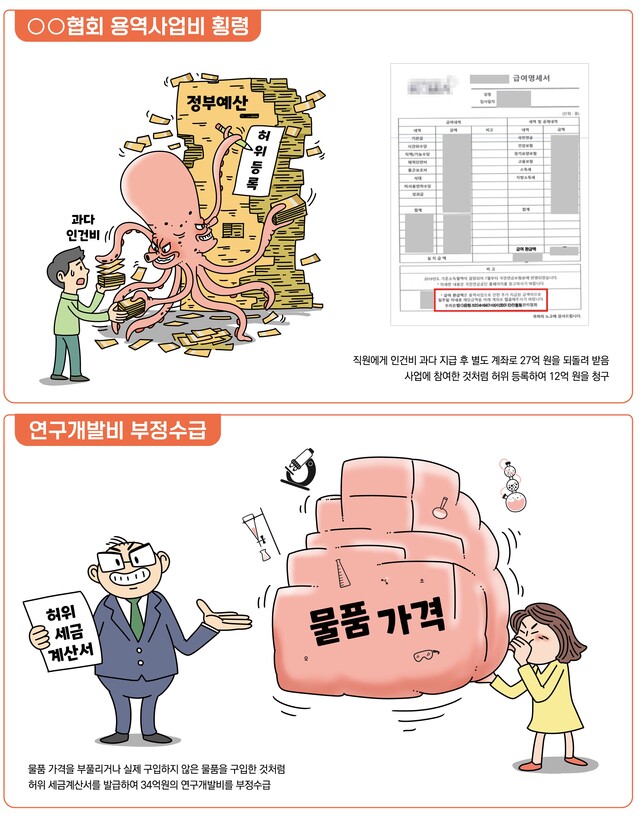
The Anti-corruption & Civil Rights Commission confirmed that Association A, which was commissioned by the Ministry of Climate, Energy and Environment to carry out a project, embezzled about 3.9 billion won (about $2.83 million) in government subsidies from 2016 to 2022.
From 2016 to 2020, Association A paid its employees excessive labor costs and then had them return, to a separate account, the amount exceeding the monthly salary set by the association, siphoning off about 2.7 billion won (about $1.96 million) through this method.
It emerged that even though employees' pay statements included a notice from the association saying, "Please return the additional amount paid," the supervisory agency was unaware of this.
Association A also falsely registered 64 employees as participating in the project over four years, from 2018 to 2022, improperly pocketing about 1.18 billion won (about $855,000) in labor costs.
During this process, it was revealed that a full-time vice president of Association A involved in the embezzlement of labor costs was a former senior official from the supervisory agency. As a result, six people, including the vice president, received disciplinary actions.
In another case, Company B embezzled about 3.4 billion won (about $2.46 million) in research and development funds by inflating the prices of goods and obtaining false tax invoices for items it had not actually purchased, among other methods.
The Ministry of Trade, Industry and Energy (MOTIE) recovered a total of about 9.8 billion won (about $7.1 million) for the treasury, including about 6.4 billion won (about $4.64 million) in embezzled R&D funds and penalty surcharges from Company B, and the director at Company B who led the scheme was sentenced to three years in prison, suspended for four years.
Meanwhile, the Anti-corruption & Civil Rights Commission is investigating the status of penalty surcharge imposition by various agencies in areas vulnerable to improper subsidy receipt. As part of this effort, it inspected the voucher service sector from October last year to April this year.
The inspection found that about 28,000 cases of fraudulent voucher-related claims had been detected since 2020, and that 64 local governments had failed to impose about 22.2 billion won (about $16.09 million) in penalty surcharges. The Anti-corruption & Civil Rights Commission recommended that the local governments impose the penalty surcharges.
By region, Gyeonggi Province had the largest shortfall in sanctions at 7.5 billion won (about $5.43 million) across 34 cases, followed by ▲South Jeolla Province (3 cases, 2.46 billion won, about $1.78 million), ▲South Chungcheong Province (19 cases, 2.23 billion won, about $1.62 million), ▲Busan (11 cases, 1.8 billion won, about $1.3 million), and ▲Seoul (11 cases, 1.4 billion won, about $1.01 million).
By project, ▲activity support for people with disabilities accounted for the largest share (77 cases, 15.1 billion won, about $10.94 million), followed by ▲community service investment (37 cases, 6 billion won, about $4.35 million) and ▲daytime activity services for people with developmental disabilities (3 cases, 200 million won, about $145,000).
Additionally, to prevent improper receipt of government subsidies, the Anti-corruption & Civil Rights Commission is operating an intensive reporting period until the end of July.
From the moment a report is filed, whistleblowers' identities and confidentiality are thoroughly protected, and if a report leads to a direct recovery of revenue by a public institution, the whistleblower can receive a reward of up to 3 billion won (about $2.17 million), depending on their contribution.
Jung Seung-yun, vice chairman and secretary-general of the Anti-corruption & Civil Rights Commission, said, "Government money comes from taxpayers' hard-earned money, so not a single won should be wasted." He added, "We will encourage reporting to root out fraudulent claims and intensively inspect areas prone to such fraud, including research and development funds."


0 Comments
No comments yet.