
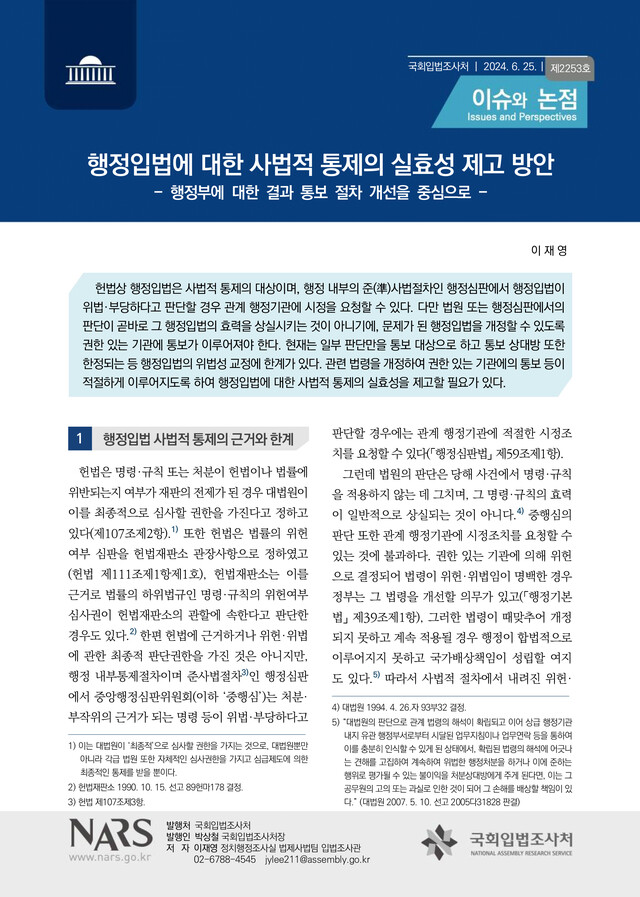
2024.06.24. The Fair Economy — The National Assembly Research Service announced on the 25th that it had published an "Issues and Points" report titled "Measures to Enhance the Effectiveness of Judicial Control over Administrative Legislation."
According to the report, under the Constitution, courts have the authority to review whether orders, regulations, and dispositions violate the Constitution or laws when such violation is a prerequisite for a trial.
However, even if a court determines that an order or rule is unconstitutional or illegal, it does not immediately lose effect; revision by the competent administrative agency is required.
The government is obligated to improve statutes and regulations that a competent authority has ruled unconstitutional or illegal. However, there are aspects that need improvement in the process by which such rulings — whether from the courts or from quasi-judicial administrative procedures such as administrative appeals — are conveyed to the competent authority.
The report examined problems in the current system and potential solutions that could be considered for future improvement.
Article 6 of the current Administrative Litigation Act limits the notification recipient to the Minister of the Interior and Safety, restricts notifications to Supreme Court rulings, and requires public notice to be published in the Official Gazette — constraints that limit the extent to which such notifications lead to legislative improvement. Accordingly, measures could be considered to expand the range of notification recipients, broaden the scope of rulings subject to notification, and add the key reasoning of rulings to the content of public notices.
Currently, the notification system exists only for administrative litigation. However, since normative control also occurs in civil and criminal litigation and non-contentious cases, a legal basis is needed for those procedures as well.
This means that a channel also needs to be established for conveying findings of illegality or impropriety made in review proceedings other than those of the Central Administrative Appeals Commission under the Administrative Appeals Act to the relevant administrative agency and to the ministries responsible for legal affairs and legislative maintenance.
Modern administration frequently uses administrative legislation as a means of achieving its goals, making adequacy control over such legislation increasingly important. In particular, the shortcomings in the legislative feedback system needed to ensure the effectiveness of judicial control envisioned by the Constitution should be addressed first.
To ensure the legality of administration and protect citizens' fundamental rights, a channel needs to be established through which rulings made in judicial procedures can be properly reflected in legislative improvements.
The report concluded that, out of respect for constitutional institutions, such measures should be considered within a scope that does not undermine institutional autonomy.


0 Comments
No comments yet.