
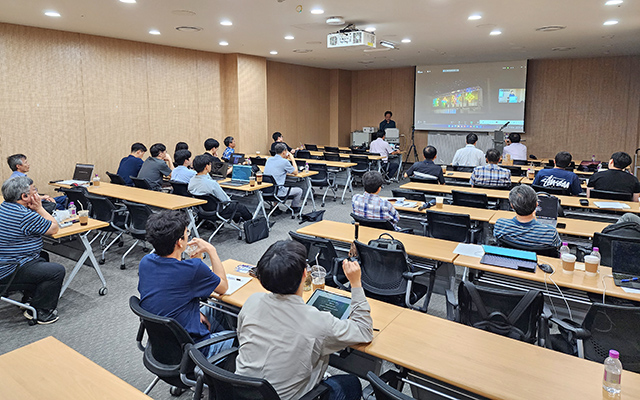
2024.07.18. The Fair Economy — The IEIE Business Committee, chaired by President Lee Chung-yong of Yonsei University, held the "Intelligent XR Technology and Application Workshop for Spatial Computing" on the 18th at the Korea Science and Technology Center in Gangnam-gu, Seoul.
During the workshop's first session, which began in the morning, Jung Il-gwon, head of the ETRI headquarters, served as chair for the theme "XR Technology in the Age of AX (AI transformation)". The session featured: ▲ Introduction of ultra-realistic 3D content-based digital twin trends (Shin Gwang-seop, head of Epic Games); ▲ XR-based remote collaboration: current status and challenging tasks (Woo Un-taek, professor at KAIST); ▲ Digital human development history and real-world application cases (Choi Seong-ho, CTO of GiantStep); ▲ National heritage AX: digital transformation of national heritage using AI technology and XR applications (Lee Seung-jae, principal researcher at ETRI); and other presentations.
Following that, the second session, chaired by Ryu Eun-seok, professor at Sungkyunkwan University, focused on "Spatial Media Compression and 3DGS Rendering Technology". The session featured: ▲ 3D spatial media compression encoding technologies (VPCC, GPCC, VMesh, MIV, Shim Dong-gyu, professor at Kwangwoon University); ▲ 3D spatial video representation technology and MPEG-INVR standardization trends (update, Bang Geon, principal researcher at ETRI); ▲ NeRF and 3DGS implicit/explicit 3D scene representation technologies (Park Eun-byeong, professor at Sungkyunkwan University); ▲ Current status of 3D Gaussian Splatting (3DGS) technology (Park Jae-sik, professor at Seoul National University); and other presentations.
IEIE President Lee Chung-yong said, "Recently, research and development (R&D) and commercialization of intelligent extended reality (XR) technology for spatial computing have been actively progressing. Through this workshop, we expect that important content such as spatial computing technology and application cases for next-generation XR services will be well communicated to domestic researchers, providing practical assistance to institutions and academia conducting related research."
IEIE, founded on November 26, 1946 as the Korea Telecommunications Society, after going through the turmoil of the early post-war period including the 6.25, renamed itself in April 1963 as the Institute of Electronics and Information Engineering (a private corporation) and obtained permission to publish the Journal of Electronics and Information Engineering and to establish the corporation.
IEIE actively conducts academic projects such as domestic and international academic conferences, short courses, seminars, and lectures; publication projects for academic journals, society journals, books, and technical information magazines; academic and technical research projects; and activities for establishing standard specifications.


0 Comments
No comments yet.