
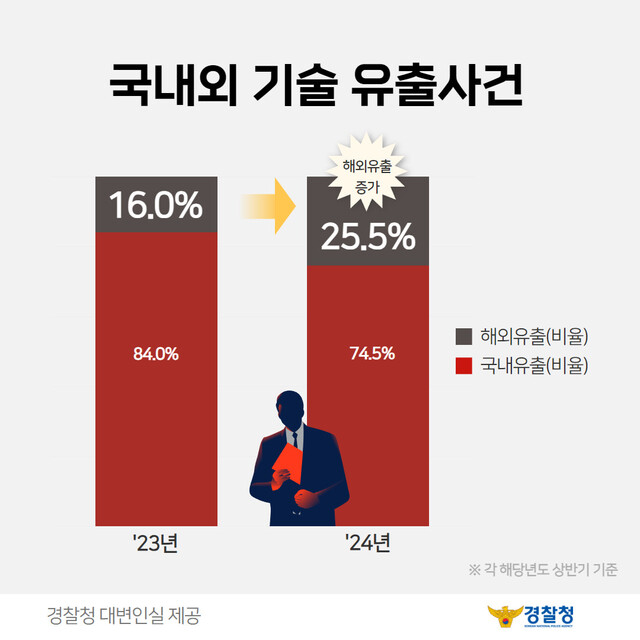
2024.07.19. The Fair Economy — The National Office of Investigation's Security Investigation Bureau under the National Police Agency said on the 18th that, as a result of shifting its operational focus to actively responding to overseas technology leak crimes, the number of arrests for overseas technology leaks in the first half of this year increased by 50% compared with the same period last year.
Since 2023, the police have focused on cracking down on overseas technology leakage crimes, designated dedicated technologies for each investigative team according to the characteristics of local industrial complexes and other regional specifics, and have continuously encouraged field activities by evaluating not only arrest performance but also field activity performance.
As a result, overseas tech leakage cases rose 83% in 2023 compared with 2022 (from 12 to 22), and the share of overseas leakage cases detected by police continued to grow, with first-half detections this year up 50% from the same period last year (from 8 to 12).
The share of cases identified through intelligence gathering or other means also showed an upward trend, rising from 34.8% in 2021 to 39.4% in 2022 and 43% in 2023.
By applicable charge across all tech leakage cases, violations of the Unfair Competition Prevention Act were the most common at 33 cases (70.3%), followed by 9 Industrial Technology Protection Act cases (19.1%) and 4 Criminal Act (breach of trust) cases (8.5%).
By the type of leaked technology, domestic leaks were led by machinery (8 cases, 23%) and information and communications (6 cases, 17%), whereas overseas leaks were led by semiconductors (4 cases, 34%) and displays (3 cases, 25%), showing differences in the affected technologies between domestic and overseas leaks.
In terms of the method of leakage, email (13 cases, 29%) was the most common, followed by USB (9 cases, 19%), external hard drives (8 cases, 17%), and cloud (5 cases, 11%), indicating that cases of technology being transferred via typical methods such as email and USB remain prevalent. By victim company, small and medium-sized enterprises accounted for the majority (38 cases, 80.9%), and the majority of leakers were insiders (38 cases, 80.9%).
Valuing damages in tech leakage cases is difficult, making it hard to secure criminal proceeds. However, in the first half of this year, police secured a total of 470 million won in criminal proceeds from two tech leakage cases by identifying and seeking pre-trial seizure of salaries and stay costs received by suspects who leaked national core technologies.
A spokesperson from the Security Investigation Division said, "If you have suffered technology leakage damage or witnessed a suspicious case around you, please report to 113 without an area code or to the online 113 reporting center set up on the police website (www.police.go.kr), or visit the provincial police industrial technology protection investigation team for consultation."


0 Comments
No comments yet.