
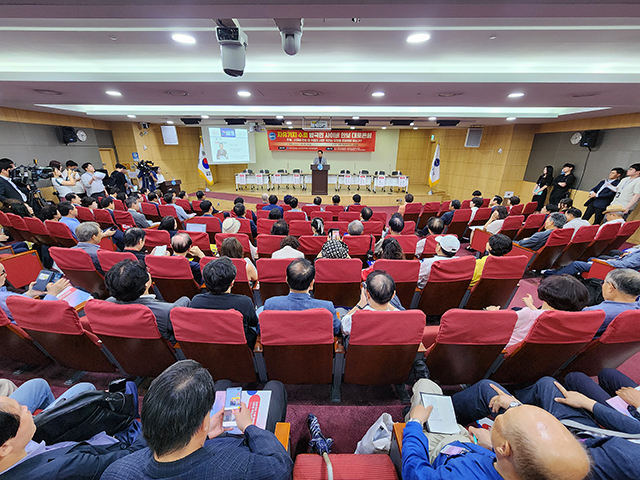
2024.07.24. The Fair Economy — A consensus is forming around the idea of launching a nationwide 'Cybersecurity Guardian Movement' to defend the free democratic basic order enshrined in South Korea's Constitution against the growing cyber threats posed by North Korea and others. The goal is to make cybersecurity not someone else's problem but everyone's own concern, and to build response capacity at the individual, family, community and national levels.
Rep. Lim Jong-deuk of the National Assembly's Defense Committee and Rep. Park Duk-hyum of the Agriculture, Food, Rural Affairs, Oceans and Fisheries Committee, together with the Korea Freedom Federation, held the '2024 National Cyber Security Forum for the Protection of Freedom Values' on the 24th in Meeting Room 2 of the National Assembly Members' Office Building.
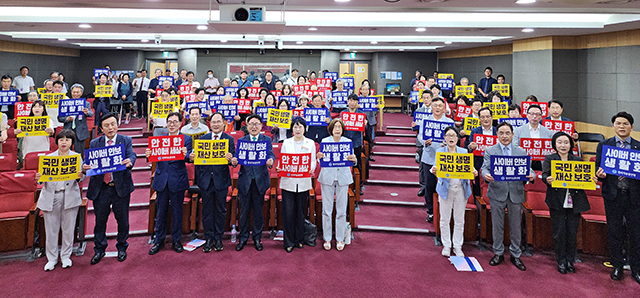
Attendees included Kang Seok-ho, president of the Korea Freedom Federation; Sung Il-jong, chairman of the National Assembly's Defense Committee; Shin Sung-bum, chairman of the National Assembly's Intelligence Committee; lawmakers Kim Gi-hyeon, Han Gi-ho, and Cho Eun-hui; Lim Jong-in, special cyber adviser to the presidential office; former Defense Minister Kwon Yeong-hae; former four-term lawmaker Yoo Jun-sang; former Third Field Army commander Lee Hong-gi; and some 200 officials from the Korea Freedom Federation, the Information Science and Technology Innovation Forum, and the National Cyber Security Association.
On that day, the Korea Freedom Federation read a 'Cyber Security Resolution' pledging to lead public opinion toward building capabilities to respond to cyber threats in both public and private sectors and to fulfill its responsibilities and duties as a cyber security guardian.
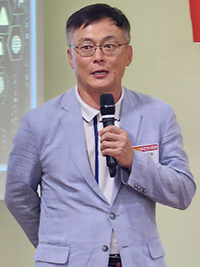
After the resolution was read, Kang Seong-ju, a visiting professor at Sejong University and former head of Korea Post at the Ministry of Science and ICT, delivered a keynote address titled 'The Era of Major Cyber Threats: What Should We Do?'
"As the AI era arrives, new social and economic innovations are emerging alongside unprecedented cyber threats," Kang Seong-ju said. "In particular, traditional threats such as hacking, spam and malware are evolving through the use of AI."
He stressed that a safe AI world does not come automatically, arguing that new awareness of and countermeasures against cyber threats are now needed. Specifically, he said legal and institutional measures, such as AI laws and guidelines, must be established, and technical measures, including fostering the AI security industry and training talent, should also be implemented. He further proposed that a 'national movement' emerge to actively pursue AI ethics standards, international cooperation, and education and training.
Kang Seong-ju concluded his presentation by saying, "Attention and investment are needed to thoroughly prepare for AI safety."
Next, Kim Heung-gwang, head of the NK Knowledge Alliance, presented on "The Growth of Organized Cybercrime Under Kim Jong Un's Direct Command and Our Response," and Seung-joo Kim, a professor at Korea University's Graduate School of Information Security, presented on "What It Takes for the Cybersecurity Guardian Campaign to Succeed."
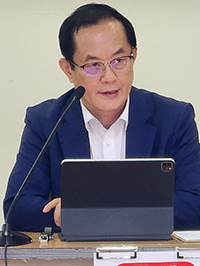
Kim Heung-gwang said, "Since October 2022, the North Korean regime under Kim Jong-un has newly established a direct command system over its cyber units and is deeply and directly involved in external cyber attacks and hacking warfare," and assessed that "the establishment of the direct command system and the consequent transformation and refinement of strategies and tactics can be seen as indicating that North Korea has secured human and technical capabilities to gain an offensive edge over South Korea, and that it is highly likely to launch more sophisticated and effective operations by linking various attack know-how and information assets."
Noting that attacks of every level are being positioned for potential future use in cyberterrorism or cyberwarfare, he said that a security system divided by sector can no longer respond effectively, and argued that South Korea's strategy for effectively countering and deterring North Korean cyberattacks must combine: ▲ a national-level policy response (establishing a national cyberattack response system); ▲ an international-level policy response (leading discussions on a North Korea-China separation strategy and the application of international law); and ▲ a technical response (research and development on source tracing and cyberattack technology).
Kim Heung-gwang argued, "We must build sufficient cyber war-fighting capability to strike the enemy and frustrate their will to attack, while at the same time undertaking peaceful and diplomatic efforts to bring many countries, including North Korea, to the table for dialogue to establish international norms and principles in cyberspace that fundamentally prohibit the national use of force in cyberspace."
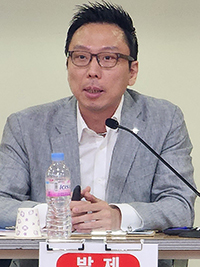
Professor Seung-joo Kim pointed out, "If security is made convenient from the user's perspective, the security level of companies and institutions can be greatly improved," and "we must move away from the existing practice of imposing excessive, inconvenient, and unreasonable security policies."
He said South Korea's uniform network separation policy in the public and financial sectors also needs to be improved in this regard, and touched on the need for the government to reform related regulations.
Furthermore, he said that while information security technologies have limits in preventing security incidents, a compensation system is crucial when incidents occur.
He also expressed the view that a balanced workforce training policy is needed in the cyber security field, and that it is time to focus on nurturing 'information security engineers' — defenders rather than attackers like white-hat hackers.
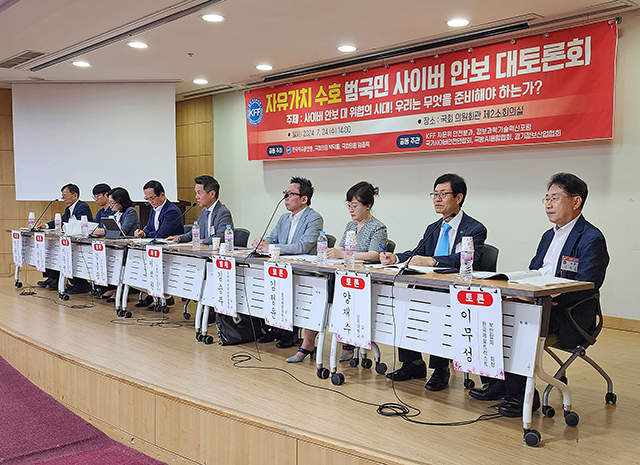
Afterward, Lee Seok-won, a professor at the Graduate School of Public Administration at Seoul National University, served as moderator for a session of issue presentations and discussions by cybersecurity experts.
Participants in the discussion included Lee Dong-yeon, director at Kisa (Korea Internet & Security Agency); Kim Jeong-yun, professor at Korea Maritime and Ocean University; Choi Sang-myeong, CEO of Issue Makers Lab; Yang Jae-su, chairman of the Gyeonggi Information Industry Association; Lee Mu-seong, chairman of the Korea Zero Trust Security Association; and Park Sun-mo, PhD, of the National Cyber Security Association.
Professor Kim Jeong-yun suggested, "For the success of the cyber security guardian campaign, it is necessary to enact a basic cyber security law, strengthen punishment for cyber crimes, strengthen corporate cyber security obligations, clarify corporate responsibility in case of personal information leaks, expand victim relief measures, and make cyber security education mandatory, operating regular education programs in schools and local communities."
Professor Yang Jae-su proposed a security measure to counter threats to social overhead capital (SOC) hacking, suggesting IoT-based integrated monitoring and command for each local government's vulnerable areas and critical facilities during emergencies. He also argued that establishing a dedicated local workforce system and creating a National Security Office under the Prime Minister's office for integrated monitoring and response are necessary.
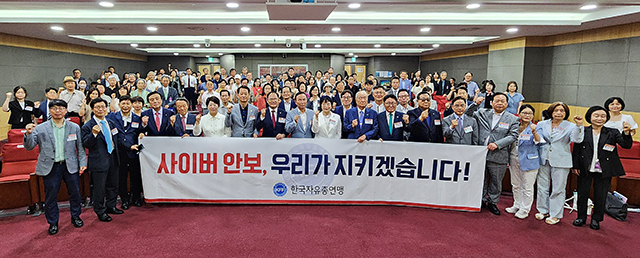
Rep. Lim Jong-deuk, who hosted the event, said, "While government-level responses to cyber crime and threat prevention are important, there is a need to develop them into a nationwide cyber security guardian movement."


0 Comments
No comments yet.