

2024.06.24. The Fair Economy — Allegations have emerged that a "substandard product" failing to meet required specifications was proposed and delivered under a public project to build an extended reality (XR) studio and link it with an existing system. During the bidding process, opinions were raised that it was necessary to verify whether a substandard product had been proposed, but the commissioning agency reportedly ignored them. The agency also refused outright to disclose related materials, citing concerns that doing so could infringe on the business secrets of the company that won the contract.
The controversy recently erupted over the 'Metaverse Hub XR VP (Virtual Production) Studio Construction and Upgrade Service' project (Public Procurement Service National e-Procurement bidding announcement number 20231000236), which was announced and pursued in October last year by the Gang-neung Science Industry Foundation (Chairman Kim Hong-gyu, Mayor of Gangneung; Director Kim Nam-su).
'Negotiated Contract' Adopted to Verify Interoperability with Existing Systems
The foundation allocated a budget of approximately 970 million won (about $700,000) and ordered the project, which includes: ▲ Construction of an LED-based XR virtual studio LED media wall and supply/installation of studio equipment to support in-camera VFX (ICVFX) and the MICE industry; ▲ Optimization of connectivity with the previously established Northeast Asia Metaverse Hub system.
The project was conducted using the 'contract by negotiation' method under the Act on Contracts to Which a Local Government Is a Party (Local Contract Act).
This method is adopted when expertise, technicality, creativity, urgency, or safety in contract performance is required. It is characterized by proposal evaluation committees assessing proposals submitted by bidding companies from a qualitative perspective.
The 'technical evaluation score' (maximum 90 points), which combines the qualitative evaluation score of the evaluation committee (maximum 70 points) and the quantitative evaluation score of the project manager (maximum 20 points), is added to the 'price evaluation score' (maximum 10 points) based on the bid prices submitted by participating companies. The company with the highest total score is selected as the priority negotiation candidate.
The ordering agency negotiates with the priority negotiation candidate and signs a project performance contract upon completion of negotiations. If negotiations break down, the ordering agency proceeds to negotiate with the next eligible candidate.
Since proposal evaluation carries the largest weight in negotiated contracts, success or failure is often determined at this stage. Typically, if a substandard product that is insufficient to achieve the project's purpose is proposed, it is filtered out during the proposal evaluation.
In this project, however, controversy erupted over allegations that a certain company proposed a substandard product yet still received a high score at the proposal evaluation stage and went on to win the contract.
Emphasis on 'interoperability with systems built through prior projects'
A review of the Request for Proposal (RFP) for the project shows that the foundation presented interoperability with systems built through prior projects as a key issue. This is because it would be difficult to integrate and operate XR infrastructure if the deliverables of subsequent projects do not properly interoperate with existing systems.
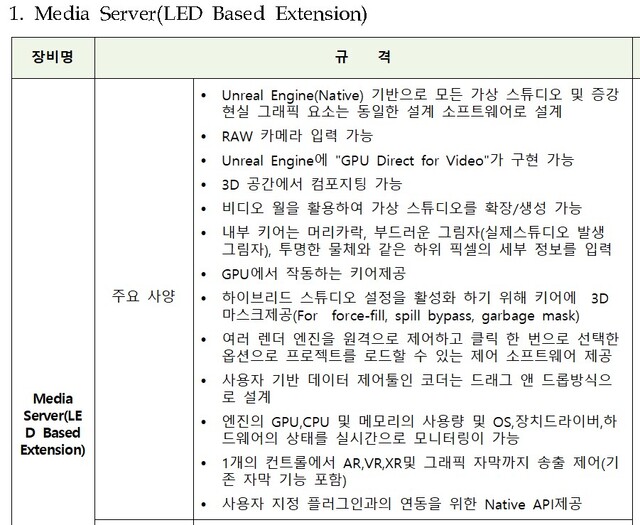
Through the detailed per-equipment specifications in the RFP, the Foundation set out requirements for the "media server" used to upgrade the metaverse hub infrastructure linkage, so that it could support XR content production by linking with the LED wall or the existing camera tracking system. The specifications required: ▲ designing all virtual studio and augmented reality graphic elements with the same design software, based on Unreal Engine Native; ▲ the ability to implement "GPU Direct for Video" in Unreal Engine; and ▲ the ability to expand or create virtual studios using a video wall.
Since the foundation's existing operating system produces 3D content using Unreal Engine, it is analyzed that the foundation required the project to be based on Unreal Engine to ensure smooth integration with the existing systems.
For the "4-channel recorder & player," which was to record and play back source footage and program (PGM) footage for LED-based XR content and MICE broadcasts, the specifications required: ▲ support for input/output of various file formats including MXF; ▲ support for input/output through various physical interfaces; ▲ support for audio mixing and 16-channel audio processing; and ▲ support for linked operation with the existing all-in-one production server, media asset management (MAM) system, and broadcast server.
For the LED screen specifications of the "LED volume system" used to build the Metaverse Hub XR VP studio, the RFP required: ▲ SMD LED type (4-in-1); ▲ brightness of 1,500 cd/㎡; ▲ refresh rate of 7,680Hz or higher; ▲ resolution of 4,224 x 1,728 pixels or higher; ▲ viewing angle (H/V) of 160°/140°; ▲ LED pixel pitch of 2.6mm or less; and ▲ KC certification (electromagnetic compatibility certification).
It has been confirmed that when these specifications were pre-disclosed on the Public Procurement Service's National Marketplace, no opinions were raised that the specifications should be modified. A representative of a video media infrastructure manufacturer said, "In the pre-disclosure process of the RFP, opinions are usually raised to modify 'specific specifications,' such as ▲ specifications requiring excessive technology like patents or ▲ specifications favorable only to specific products. The fact that there were no significant modification opinions during the pre-disclosure stage of this project is proof that the industry judged the specifications themselves to be unproblematic."
According to the Ministry of Science and ICT's notice, 'Guidelines for the Construction and Operation of Broadcasting Equipment in Public Institutions,' when opinions are received from businesses during pre-disclosure, the demand agency must organize and operate a 'Proposal Review Committee' that finalizes the RFP by reflecting the draft RFP and opinions from prospective bidders. However, if the demand agency accepts the opinions and reflects them in the RFP, the committee's organization and operation may be omitted.
Whistleblowers: 'A slew of substandard products were proposed'
Recently, however, specific allegations have surfaced that a particular company proposed substandard products during the proposal evaluation for this project.
Two companies, T and D, participated in the proposal evaluation, and the main allegation is that the products proposed by T in its proposal did not meet the RFP's required specifications.
Whistleblowers commonly said, "Because the domestic XR industry market is small, information about who participated in which project, what products they proposed, and what products were ultimately delivered is shared almost in real time. However, there have been constant stories that this project proceeded in a process that is hard to understand."
First, there are suspicions that T proposed a media server that does not support Unreal Engine during the proposal evaluation.
Multiple whistleblowers said, "Since the system built and operated through prior projects produces 3D content based on Unreal Engine, the RFP required the media server to operate natively with Unreal Engine on this basis. However, industry sources say the product proposed by T during the proposal evaluation does not support Unreal Engine."
An expert who has served on proposal evaluation committees for several XR public projects said in a phone call, "I understand that several of the evaluation committee members for this project were not XR experts. Therefore, it would have been difficult for them to judge and evaluate on the spot what products T proposed. In other public projects, when evaluation committees cannot be composed of experts, the committee formation process is sometimes redone, but that did not happen in this project."
There were also allegations that the 4-channel recorder/player proposed by T did not meet specifications.
In response, a video equipment infrastructure design expert said, "According to industry rumors, the product T proposed lacks recording functionality to formats such as MXF. If such a product was proposed as a recorder, it should have received a failing grade during the proposal evaluation."
MXF is an industry-standard specification capable of containing audio, video and metadata together, and is a container format used in professional video production for shooting, editing and transmission. It is used when recording with various professional cameras made by Sony Corporation, Canon Inc. and Panasonic, and is also adopted in broadcast transmission, tapeless archiving and post-production.
Opinions were also raised that "in other public projects, if substandard products of this level are proposed, the company proposing them is given a significantly low score ('failing treatment'), or the proposal evaluation is sometimes redone entirely."
Allegations were also raised about the LED screen product proposed by T.
The RFP required that the LED screen be a 4-in-1 LED package type product made of SMD capable of displaying four colors — red, green, blue and white — and that it be KC-certified to verify electromagnetic safety during operation. 4-in-1 SMD products are known to be well-suited to XR studios because of their durability.
In contrast, whistleblowers alleged that T proposed a 3-in-1 SMD LED type product composed of red, green, and blue. They also said that the product had not received KC certification at the time of the proposal evaluation.
'Request to Verify Substandard Products Rejected by the Foundation'
Allegations related to this project began to emerge from the time of the proposal evaluation.
Some evaluation committee members raised the need to verify whether the proposed products met specifications.
According to proposal evaluation materials obtained by The Fair Economy, one evaluation committee member submitted an evaluation opinion to the foundation while evaluating T, stating, "Verification of interoperability with the existing system (media server) is needed."
Industry sources say that when such opinions are raised during proposal evaluation, the ordering agency is responsible for verifying them.
However, it is known that the foundation, as the ordering agency, did not conduct separate verification until it signed a project performance contract with T. In response, industry observers assessed that "the foundation 'charged ahead' looking only forward to sign the contract."
Furthermore, it has been confirmed that after the proposal evaluation, requests to verify the specifications of the proposed equipment were made to the foundation, but the foundation refused these requests, citing "inability to disclose proposals."
This was a rejection based on mistakenly treating a request to confirm whether a substandard product had been proposed as a request for information disclosure. The whistleblowers believe the Foundation deliberately pretended to misunderstand the request in order to ignore it.
Whistleblowers and industry experts pointed out, "The foundation should have verified whether the proposed products met specifications before signing the contract, and if the allegations turned out to be true, it should have re-conducted the proposal evaluation or begun negotiations with the next-ranked bidder."
The foundation has categorically denied these allegations.
A project manager at the foundation responded, "Bidding companies proposed products and specifications of equal or higher grade for project performance and solutions that met the specification sheets. The evaluation committee, composed through public recruitment and lottery, assessed these solutions as suitable."
However, the Foundation refused The Fair Economy's request to disclose what products had been proposed during the proposal evaluation for this project, citing that "the proposing company requested non-disclosure under Article 9(1)7 of the Act on Disclosure of Information by Public Agencies."
Under this provision, "information concerning the management or business secrets of a corporation, organization or individual that, if disclosed, is deemed likely to significantly harm the legitimate interests of that corporation, organization or individual" may be withheld from disclosure.
The request was to disclose the models of the proposed products, while keeping the proposed prices (which reveal the delivery cost) confidential. However, the foundation appears to have judged that disclosing which products were proposed would in itself infringe on the companies' management and trade secrets.
Whistleblowers said, "The reason the foundation does not disclose which products were proposed during the proposal evaluation is obvious. It is because substandard products were indeed proposed, and disclosing them would reveal the foundation's wrongdoing in unreasonably pushing forward with a contract with a company that proposed substandard products. The foundation should transparently disclose project-related information now."
Meanwhile, the Gangneung City Council is currently conducting an administrative audit of the foundation, and it is known that the council has requested the foundation to submit information related to this project.
[Right of Reply] Regarding the Article "[Exclusive] Gang-neung Science Industry Foundation 'Barrels Ahead' to Contract Despite Allegations of 'Substandard Product' Proposal"
On June 24, this newspaper reported under the title '[Exclusive] Gang-neung Science Industry Foundation 'charges ahead' with contract despite 'substandard product proposal' suspicions' that in the 'Metaverse Hub XR VP Studio Construction and Upgrade Service' project announced and pursued by the Gang-neung Science Industry Foundation (the foundation) in October last year, a substandard product was proposed yet received a high evaluation score at the foundation's proposal evaluation stage and proceeded to contract.
In response, the foundation stated, "The products proposed by T, which won the bid for this project, were of higher specifications than required in terms of compatibility, latest version, and quantity from the time of the proposal presentation evaluation." It added, "The proposal evaluation committee was composed of experts in broadcasting and communication technology, including XR experts, and no evaluation committee member raised opinions regarding substandard specifications."
Additionally, the foundation said, "We cooperated as much as possible within the scope of consent obtained from each company for the information requested by the reporter."
This report is based on the mediation of the Press Arbitration Commission.


0 Comments
No comments yet.