
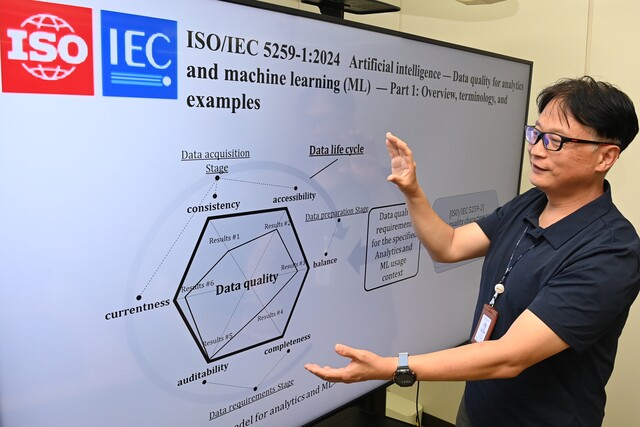
2024.07.16. The Fair Economy — The Electronics and Telecommunications Research Institute (ETRI) announced on the 16th that its "Data Quality Standard for Data Analysis and Machine Learning," which it has been promoting and developing for international standardization in the artificial intelligence (AI) field, has been established as an international standard.
According to ETRI, this new international standard will allow customers to judge whether to purchase data based on evidence of its quality. It also provides a benchmark for continuously improving the quality of data used during AI development.
The project leader is Ha Su-uk, technology general manager at ETRI's Strategic Standards Research Lab.
The research team established an overview and common concepts for data quality used in AI within the "Data Quality for Data Analysis and Machine Learning" series, which consists of six parts.
First, they led the development of "Part 1: Overview, terminology, and examples," which helps understand and apply series standards such as ▲data quality measurement ▲data quality management requirements ▲quality management procedures.
The adopted standard provides organizations with tools and methods to assess, manage, and improve data quality during AI development in the era of data-driven decision-making.
It helps ensure data is used fit for purpose and presents common terminology and practices that are consistent and reliable.
The standard developed by ETRI researchers focuses on ensuring safe AI model development and minimizing errors and biases through data quality assurance; enhancing the reliability of AI systems to maintain performance consistency while managing the data lifecycle; and supporting AI safety by aiding in risk management and regulatory compliance.
ETRI particularly noted that this is the world's first standard supporting AI safety and reliability from a data quality perspective.
The institute also expects that this will help secure AI reliability and stability, as well as facilitate compliance with future regulations, thereby reducing legal disputes and easing oversight by regulatory bodies.
Furthermore, it is expected to enhance interoperability between companies and promote the development of innovative AI application services based on high-quality data.
Building on this achievement, the research team will develop international standards for data requirements, usage information, and machine learning model sharing information according to the data lifecycle in AI development environments to support AI reliability and stability.
To this end, they plan to continue cooperation with the data working group under the international standards research group, including the United States, Japan, Germany, China, and the United Kingdom, as well as domestic experts from industry, academia, and research institutes.
"This standard was adopted as an international standard with active support from member countries," said Lee Seung-yun, head of ETRI's Standards Research Division. "It provides a crucial benchmark for evaluating data quality for AI development, which is expected to contribute to improving the reliability and performance of AI technology. It holds significant meaning at a time when our country is establishing an AI Safety Institute."
The research team predicted that this international standard will play an important role in laying the groundwork for responsible development and deployment of AI systems and strengthening cooperation among various stakeholders.
The research team said that this standard was achieved through the Ministry of Science and ICT's projects "Development of AI Data Standards for the Diffusion of Intelligent Information Technology" and the "AI Standards Professional Research Lab."


0 Comments
No comments yet.