
2024.06.28. The Fair Economy — Internet governance is a democratic consensus-building activity in which diverse internet stakeholders gather to voluntarily propose policies and deliberate, establishing internet-related principles, rules, and standards in a bottom-up manner. Recently, to broaden the scope of internet governance discussions, the government, businesses, civil society, academia, the technical community, and users came together.
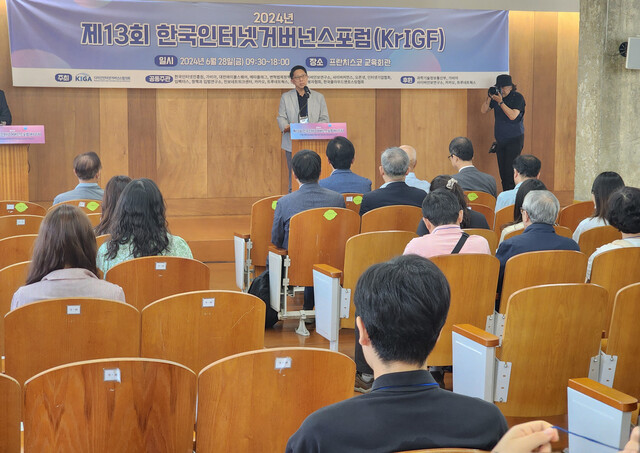
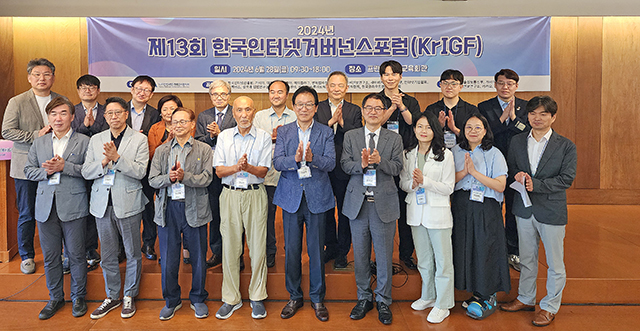
The Korea Internet Governance Alliance (KIGA), chaired by Lee Dong-man, a professor at KAIST, held the 13th Korea Internet Governance Forum (KrIGF) on the 28th at the Franciscan Monastery Education Center in Jung-gu, Seoul. The event brought together 17 internet-related organizations, groups and companies, including the Korea Internet & Security Agency (KISA), along with experts.
KIGA is a body composed of diverse stakeholders from industry, public institutions, civil society, academia and the technology sector, formed to respond systematically to internet governance issues being actively discussed at home and abroad.
The KrIGF has been held annually since 2012 to promote discussions among various stakeholders on key public policy issues related to the internet.
The 13th forum, themed 'Multistakeholder Governance for Safety and Human Rights in the AI Era,' was held simultaneously online and offline.
'Multistakeholder' is a term referring to a process in which various groups with an interest in managing an issue participate and determine management principles, norms and decision-making procedures through mutual consultation.
In the field of internet governance, multistakeholderism is cited as a core operating principle under which government, industry, public institutions, civil society, academia and users participate equally in managing and operating the internet, including technology and public policy issues.
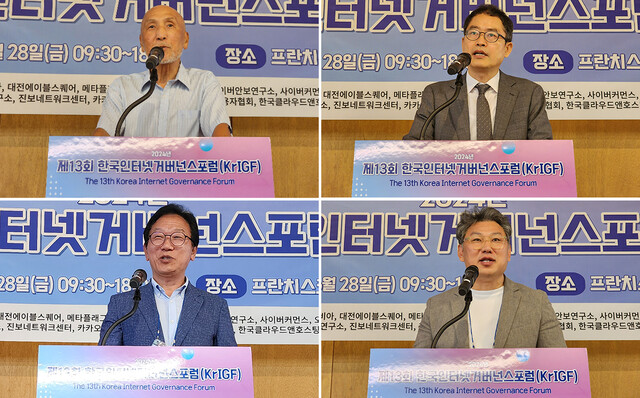
In his opening remarks, KIGA Chair Lee Dong-man said, 'Generative AI such as ChatGPT is permeating our daily lives. The internet, as infrastructure, is essential for the smooth use of AI. I hope this event will lead to fruitful discussions on desirable internet governance and the gathering of new ideas.'
Lee Sang-jung, head of KISA, represented the public sector; Yoon Bok-nam, chair of KIGA's domain name subcommittee, represented civil society; and Joo Yong-wan, a professor at Kangneung-Wonju National University, represented the technology sector in their opening addresses.
Following a congratulatory address by Jeon Gil-nam, an emeritus professor at KAIST who developed the internet in South Korea, Eom Yeol, director of information and communication policy at the Ministry of Science and ICT, delivered a video message.
The event was divided into three tracks—cybersecurity, AI and governance—and featured 12 sessions covering various internet issues, including UN digital cooperation agendas, tutorials on internet routing security, country code top-level domain (.kr) policy, AI technology and a 'Youth Session' hosted by young people.
Participants agreed that to ensure all citizens of the world can access and use the internet equally and freely, diverse stakeholders must not only participate in discussions on an equal footing but also determine institutional and technical matters through consultation as equals.
Meanwhile, in South Korea, the non-profit Krnic has been responsible for managing internet resources such as IP addresses and country code top-level domains. However, it was incorporated as a department under KISA, a public institution, in 2009.


0 Comments
No comments yet.