
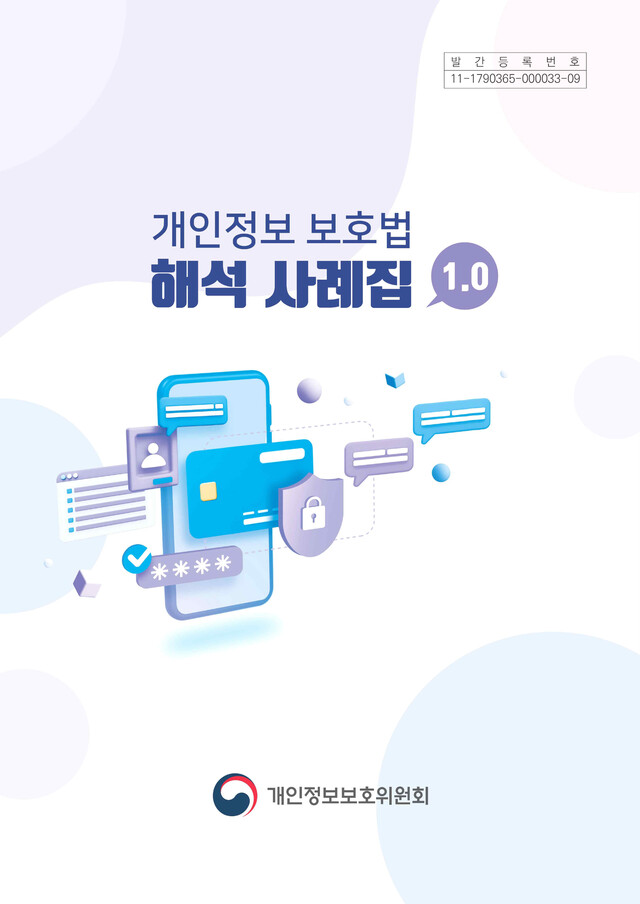
2024.06.30. The Fair Economy — The Personal Information Protection Commission (PPC) said on the 30th that it recently released a new "Interpretation Casebook on the Personal Information Protection Act," which consolidates existing interpretation casebooks into an easily accessible format for the public.
Since its establishment, the PPC has annually selected representative cases from inquiries to public institutions and the National Petition Center regarding interpretations of the Personal Information Protection Act, publishing documents such as 'Standard Interpretations' and 'Major Issue Legal Interpretation Casebooks.'
The PPC explained that it published the case book to reduce confusion in legal interpretation by reflecting the revisions made in the comprehensively amended Personal Information Protection Act, which took effect in September last year, and to make it easier for the public to find the information they need by consolidating previously scattered case books into one.
The newly published case book selected 52 timely cases from existing case books and organized them into seven categories — definition of personal information, video information, pseudonymized information, public services, private businesses, personnel and labor affairs, and schools — so that the public can easily find relevant cases.
For example, regarding whether virtual asset wallet addresses constitute personal information, the casebook explains that a wallet address processed by a virtual asset business operator may not alone be personal information, but if it can be easily combined with other information such as transaction accounts or names to identify a specific individual, it may be considered personal information.
On who should bear the cost of mosaic processing when a request is made to view CCTV footage — the data subject requesting the viewing or the institution operating the CCTV — the case book states that, in principle, the data subject requesting the viewing should bear the cost of mosaic processing and other such measures involved in the viewing.
It explained that public institutions may use employees' access records for self-audit purposes. Such records may be used for self-audit purposes under the Public Sector Audit Act, it added, but there must be no risk of unjustly infringing on the interests of the data subject or a third party, and only the minimum necessary access records should be used.
It made clear that collecting personal information necessary for membership registration without consent is permissible, since this is done to conclude a membership service contract requested by the data subject.
The PPC plans to add more high-priority cases to the casebook in the second half of this year and intends to publish updated editions annually.
The casebook is available online for all citizens on the PPC website (pipc.go.kr) or the Personal Information Portal (privacy.go.kr).


0 Comments
No comments yet.