
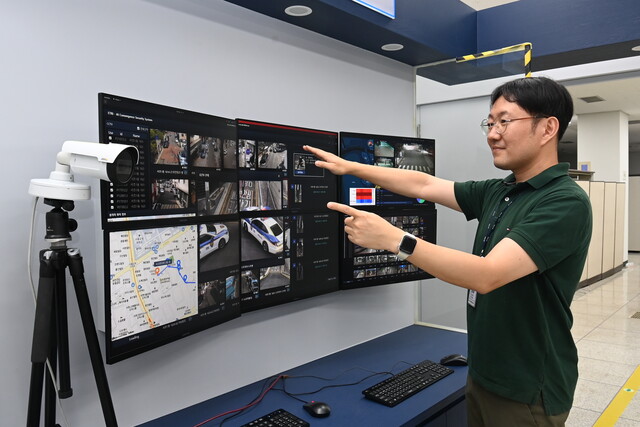
2024.07.18. The Fair Economy — The Electronics and Telecommunications Research Institute (ETRI) announced on the 18th that it has completed the development of 'Dejaview' technology, which analyzes CCTV footage, crime statistics, and location information to detect signs of crime in advance and predict the likelihood of occurrence.
The Dejaview technology developed by the research team is based on the tendency for crimes to recur in patterns similar to past incidents in terms of type, method, location, and time.
This technology is an artificial intelligence (AI) technology that measures and predicts crime risk by comparing and analyzing past crime situations with current ongoing situations.
ETRI's Dejaview technology, which probabilistically predicts crime occurrence, can be divided into two technologies depending on the target and method of application.
First, the 'spatio-temporal crime prediction technology' analyzes which types of crimes are at high risk at specific places and times.
For example, if a situation similar to past crime patterns occurs late at night in a secluded area where crimes have occurred before, it is judged to be at very high risk.
This approach aims to block and prevent crime before it happens.
It is expected to be primarily used by police and integrated CCTV monitoring centers of local governments nationwide.
AI trained on statistical information such as past crimes automatically analyzes real-time CCTV footage to compare and measure similarity with crime situations.
It can also immediately identify and track suspicious situations such as stalking, falls, and early-stage fires, and understand the overall situation by recognizing attributes of passersby and vehicles (e.g., drugs, smuggling).
ETRI jointly developed a Crime Prediction Map (PCM) with Seocho District in Seoul by analyzing big data from 32,656 CCTV incidents and accidents in the area over three years starting in 2018.
Based on historical crime statistics, it standardizes crime occurrences by time, location, violent crimes, traffic accidents, fires, and other incident types to show areas with a high likelihood of crime occurrence (PCM)
The PCM also displays real-time crime risk levels on the screen.
Operators can grasp the current crime risk level by area at a glance through the Crime Prediction Map.
This enables predictive selective monitoring, prioritizing areas with a high probability of crime.
The crime prediction performance of the Crime Prediction Map was measured at 82.8% according to the performance test standards of the Telecommunications Technology Association (TTA).
ETRI also developed 'individual-based recidivism prediction technology' as the second Dejaview technology.
This technology is applied strictly to high-risk electronic monitoring subjects with a significant concern for recidivism.
It analyzes risk levels based on the movement patterns of electronic monitoring subjects.
The current electronic monitoring system determines whether movement restriction regulations are violated based on location data.
If ETRI's technology is integrated into existing systems, when an electronic monitoring subject periodically violates movement restrictions due to work or other reasons, AI can analyze this to assess recidivism risk and respond accordingly.
The performance of location-based risk analysis for electronic monitoring subjects is at a 95% level.
TTA certification tests were completed for a total of 7,397 daily alerts.
This technology can be utilized by the Ministry of Justice's Central Location Tracking Monitoring Center.
It is expected to evolve into an AI electronic monitoring system that comprehensively analyzes not only location data but also various daily, interview, and medical information.
ETRI researchers plan to develop the fundamental technology for detecting and predicting crime signs, created this time, into a system specialized for safety services.
The institute intends to expand and apply it to various safety services, including field-customized crime prediction systems considering regional crime characteristics, pre-response systems for risks at national infrastructure such as airports, energy facilities, and factories, safety systems for major national events, and proactive responses to risky behavior (intent) for security.
To achieve this, the development of world-class video security AI core technology that accurately analyzes, understands, and infers real-time situations in CCTV footage must be supported.
Based on the developed Dejaview technology, ETRI researchers plan to cooperate with local governments and monitoring agencies to provide crime sign detection and prediction services specialized for public safety sites.
They also plan to expand into developing AI electronic monitoring technology that recognizes and responds in advance to deviant behavior by high-risk electronic monitoring subjects.
The commercialization of Dejaview technology is expected by the end of next year.
Kim Geon-u, a principal researcher at ETRI's AI Convergence Security Laboratory, said, "We have developed video security technology that goes beyond simply detecting crime occurrence to proactively predicting and preventing the possibility of risk. This technology lays the foundation for a leap into future advanced social safety systems."
The project, titled 'Development of Core Predictive Video Security Technology for Proactive Risk Response Based on 5G' under the Ministry of Science and ICT, was carried out until last year. It was selected as one of the Top 100 Outstanding Achievements in National R&D in 2023, an IITP ICT R&D 25th Excellent Project, and one of ETRI's nine representative achievements.


0 Comments
No comments yet.