
2024.08.04. The Fair Economy — Construction supervision firms rigged bids on multiple public projects in order to undermine the comprehensive evaluation bid award system, and bribed review panelists to ensure the rigging succeeded, before being caught by prosecutors.
Since the service fees for publicly ordered supervision contracts are funded by taxpayers' money, the offending firms created slush funds from those fees to pay bribes, then used the contracts they won to generate further slush funds — a structural scheme that caused massive losses to state finances.
Moreover, since bids in the public construction sector cover large-scale housing and public facilities such as apartments, hospitals and research institutes, bid rigging not only drains state finances but can also lead to substandard supervision that directly threatens the public's life and safety.
During the investigation, prosecutors held consultations with the government, ordering agencies and other relevant bodies, and decided to devise institutional reforms to prevent such crimes from recurring.
The Seoul Central District Prosecutors' Office Fair Trade Investigation Division (headed by Chief Prosecutor Kim Yong-sik) recently announced that it had investigated a case involving bid rigging in supervision contracts for major public buildings nationwide — including public and rental apartments, hospitals and police stations in Yangju, Hwaseong, Ulsan and other areas — and the provision of large sums of money to review panelists to ensure that predetermined firms won the contracts. The division indicted 68 people (7 of whom were detained) and completed measures to preserve approximately 650 million won in bribes for forfeiture.
Prosecutors indicted 17 companies and 19 individuals for violating the Fair Trade Act through bid rigging, in connection with the involved firms' rigging of 94 publicly ordered supervision bids worth a combined 574 billion won in winning bid amounts through methods such as "dividing up contracts" from October 2019 to February 2023.
Prosecutors also indicted 18 review panelists — professors, civil servants and others (6 detained) — and 20 executives and employees of supervision firms (1 detained) for violating the Act on the Aggravated Punishment of Specific Crimes (bribery), in connection with panelists accepting money from firms in exchange for favorable scores between January 2020 and December 2022.
Prosecutors stated that by conducting rapid and intensive investigations before the Korea Fair Trade Commission filed complaints, utilizing the cartel penalty mitigation system (leniency), they were able to thoroughly clarify not only the collusion by supervision firms but also the financial entanglement between the firms and review committee members.
According to prosecutors, in the early stages of the investigation, the supervision firms admitted to the bid rigging itself but remained completely silent about the specific methods used to carry it out, making it difficult to get to the heart of the case. Through a tenacious investigation that included analyzing about 12,000 recorded phone calls and reviewing a large volume of seized materials to secure key evidence of the rigging, such as "personnel fee settlement records," prosecutors were able to uncover the structural corruption, including bribery, that was pervasive throughout the supervision bidding process.
When the comprehensive evaluation bid award system was introduced in 2019, the supervision firms, acting against its intent, engaged in bid rigging to secure stable profits without competing on technical merit, winning contracts by buying high scores. Review panelists, for their part, took advantage of the situation to accept substantial sums of money. The comprehensive evaluation bid award system is a method of selecting winning bidders by evaluating them mainly on technical capability rather than price.
Prosecutors pointed out that construction costs for public buildings such as public and rental apartments, hospitals, and police stations, funded by the national treasury, were used as illegal lobbying funds, resulting in supervision failures that threaten citizens' lives and safety.
Prosecutors said, "To prevent similar crimes from recurring, we held a council with three relevant agencies, including the Ministry of Land, Infrastructure and Transport, to share the problems with the current bidding system and discuss various reform measures." They added, "We will thoroughly maintain the prosecution so that the defendants receive sentences commensurate with their crimes, and respond firmly to corruption crimes by completely stripping away illegal gains through active confiscation and forfeiture."
They continued, "We will make criminals realize that the result of unfair collusion and bribery practices is 'thorough loss, not gain.'" They added, "We will establish a system that constantly monitors and firmly punishes cartel crimes that undermine the free market competition system and harm fair trade order."
Building a Refined Ecosystem for Organized and Systematic Lobbying
According to the investigation results, the supervision firms' lobbying and bribery of review committee members were organized and carried out in stages. They essentially built a sophisticated ecosystem.
This ecosystem consisted of four stages.
In the first stage, called "routine promotion," supervision firms allocated sales efforts company-wide based on the pool of review panelists, taking into account regional, school and work ties. They then maintained close contact with and managed people registered in the panelist pool by providing money and entertainment, such as attending weddings and funerals, giving gift certificates, and treating them to drinks and golf.
After building close relationships with panelist pool registrants in the first stage, firms moved to the second stage, "soliciting specific contracts." They skillfully circumvented blind evaluations by using company-specific symbolic phrases, or "markers," so that panelists who had been lobbied could identify a particular firm's proposal. For example, Company A used the marker "Master Key" in its proposals, allowing panelists who had received solicitations to recognize that the proposal belonged to Company A. Other firms used various markers, including "Harmony," "Plus Alpha (+α)," "Vision" and "Zero Complaints."
In the third stage, firms made "advance payments and promises of later payment." On the day review panelists were selected, firms deployed sales staff by region nationwide, then contacted the selected panelists via Telegram or public phones to make solicitations. In exchange for accepting the solicitation, firms either paid money immediately ("advance betting") or promised to pay later.
After the panelists conducted their review, the final stage, "final settlement," took place. Firms paid money to panelists who gave the soliciting firm the highest score, or to those who complied with a "bomb" solicitation by giving a competing firm the lowest score.
Prosecutors explained that a "bomb" refers to giving a competing consortium the lowest possible score, and that when a panelist drops a "bomb" on a competing consortium, it raises the probability that the soliciting firm will win the contract.
The investigation found that a going rate had even emerged, under which a solicited panelist would receive 30 million won for giving the soliciting firm the highest score, and 20 million won for giving a competing firm the lowest score.
In addition, the "personnel fees" — the money used for these solicitations — were settled in cash according to the equity share of each firm in the consortium selected for the project.
Supervision Firms Maximize Ability to Siphon Taxes Through Bid Rigging
Prosecutors said that in this case, major supervision firms led an agreement to avoid technical competition and divide up the volume of ordered contracts among themselves. As a result, fair competition did not take place, ultimately leading to citizens' tax money being unfairly overspent.
The Ministry of Land, Infrastructure and Transport introduced the comprehensive evaluation bid award system in March 2019 to prevent problems such as quality deterioration caused by lowest-price bid awards and to encourage technology-based competition. In January 2019, Korea Land & Housing Corporation (LH) restricted the formation of consortiums among top-tier firms to prevent contract awards from being concentrated among a small number of companies.
As the introduction of the comprehensive evaluation bid award system increased the weight of panelists' qualitative evaluations, major supervision firms began rigging bids by using LH's announced "annual ordering plan" as a basis for designating and dividing up which firms would win contracts, and by serving as decoy bidders for one another.
The investigation found that firms involved in the rigging divided up about 70% of LH's 2020 "annual ordering plan" among themselves.
As a result, a vicious cycle took shape — "slush fund creation, bribery, contract award" — rooted in state finances.
Prosecutors assessed that the supervision firms hired former LH officials, used them to build personal networks, and then, operating with the precision of a military operation, paid review panelists large sums of cash under the guise of "personnel fees" to haggle over scores in public bid evaluations that depend on fairness for their very integrity.
They pointed out that, as a result, the firms, having to build large slush funds for bribes, were unable to invest sufficient funds in actual supervision work on-site, and firms lacking technical capability also won contracts through bribery, raising the likelihood of overall substandard on-site supervision and safety accidents.
Indeed, the collapse of the Hwajeong I-Park apartment building in Gwangju in January 2022 and the collapse of the underground parking lot at the Geomdan Xi apartment complex in Incheon in April 2023 both involved supervision firms that were targets of this investigation.
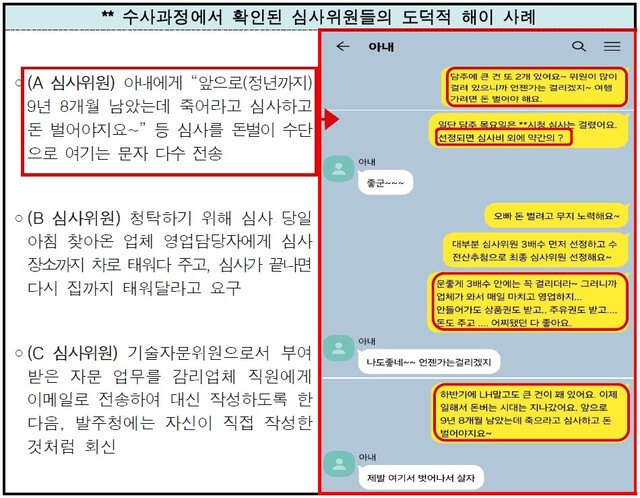
Prosecutors also noted that illegal wealth accumulation took place through covert, organized provision of money.
The firms committed their crimes in an organized manner — using messenger apps such as Telegram that make destroying evidence easy, immediately discarding documents related to the crime such as "settlement sheets," and deploying sales staff nationwide on the day panelists were selected to make solicitations and hand over money.
In addition, firms always handed over money by meeting panelists in person and paying only in cash, while panelists maintained a symbiotic relationship of shared illegality with the firms, using state finances for their own illicit enrichment.
Some panelists even pitted firms against one another to drive up the amounts offered ("race"), took extra payments for giving competing firms the lowest score ("bomb"), or took money from multiple firms at the same time ("ambidextrous") — a severe level of moral hazard.
Prosecution Moves to Formulate Institutional Improvement Measures to Block Recurrence of Crime
Prosecutors said, "In the course of the investigation, we confirmed that the 'comprehensive evaluation bid award system,' which was introduced to encourage constructive competition among firms, promote improvements in technical capability, and prevent the harms of uniform lowest-price awards, was instead being abused for bribery lobbying targeting review panelists."
According to prosecutors, firms used the higher contract amounts resulting from the system for lobbying activities, responded to restrictions on consortiums among top-tier firms with bid rigging, and, when the list of review panelists was made public to improve fairness in evaluations, used that very list to conduct all-out lobbying.
In response, prosecutors shared the lobbying practices pervasive in the supervision industry through consultations with policy-making departments, ordering agencies and other relevant bodies, and, based on this, held a council of relevant agencies to pursue institutional reforms.
In July, the Seoul Central District Prosecutors' Office Fair Trade Investigation Division held a council of relevant agencies with officials from the Ministry of Land, Infrastructure and Transport, the Public Procurement Service and LH to share the problems with the current comprehensive evaluation bid award system and discuss reform measures.
First, regarding the strong incentive for lobbying panelists that arose from concentrating authority in their hands by raising the weight of qualitative evaluation in bid reviews, it was decided to review which contracts should be subject to the comprehensive evaluation bid award system.
Regarding the fact that allowing "self-nomination," under which people could nominate themselves as review panelists, had increased the proportion of panelists in the pool seeking to be lobbied, it was decided to develop a panelist pool selection program to ensure fairness in selection and to make panelist vetting substantively effective.
In response to the criticism that announcing in advance the list of panelists selected for a particular contract gave bidding firms an opportunity to lobby them, it was decided that the list of panelists selected for a contract would no longer be made public.
Where ordering agencies' guidelines or bid announcements lacked or were unclear about prior notice of a ban on prior contact between panelists and bidding firms and sanctions for violations of the law, it was decided that such bans and sanctions would be specified in detail.
Regarding the view that prior integrity training for supervision firms and panelists was insufficient, it was decided to provide them with substantive and adequate integrity training in advance.


0 Comments
No comments yet.