
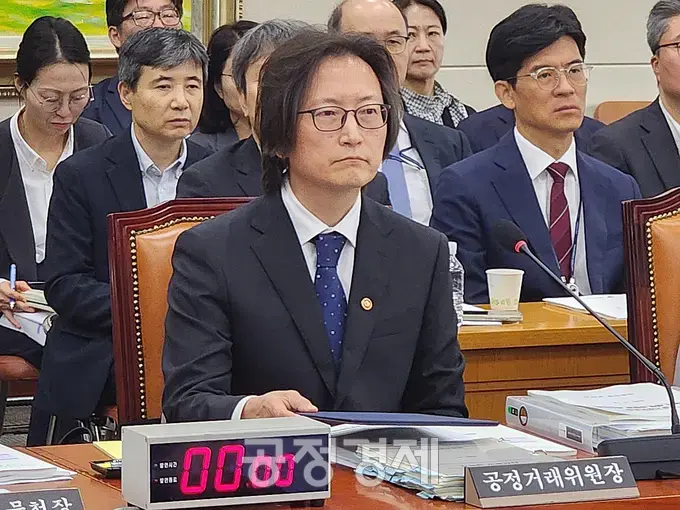
2026.10.26. The Fair Economy — Fair Trade Commission Chairman Joo Byeong-gi has proposed strengthening investigative powers to impose fines of up to 1% of total sales on companies that refuse to cooperate with investigations. He also expressed the view that the Large-Scale Distribution Industry Act, which currently allows only administrative fines for obstructing investigations, should be revised to introduce penalty surcharges and compulsory performance fines.
Chairman Joo made these remarks on KBS 1TV's 'Sunday Diagnosis Live' on the 25th.
On the same day, he stated that there is no need to grant the FTC compulsory investigation powers. He explained that most businesses cooperate with administrative investigations, so the current investigative powers are sufficient for law enforcement. He added, "If a company refuses to cooperate, strengthening investigative powers by imposing fines of up to 1% of total sales, rather than just a 'slap on the wrist,' would be more effective for law enforcement."
Other laws under the Fair Trade Commission's jurisdiction allow penalties, enforcement surcharges, and criminal sanctions for investigation obstruction, but the Large-Scale Distribution Business Act, which serves as the basis for the Coupang investigation, can only impose fines. In this case, the fine cap is 200 million won (about $154,000). For Coupang, as it is the first violation, the maximum amount that can be imposed is 100 million won (about $77,000).
In August, the FTC visited Coupang to investigate suspected violations of the Large-Scale Distribution Industry Act, but Coupang refused to comply, citing issues with the prior notification procedure, and the FTC withdrew. Coupang filed a lawsuit to cancel the disposition the same month and applied for a stay of execution. After the court dismissed the request on September 23, Coupang filed a re-appeal. The FTC has sent a review report proposing an administrative fine for obstructing the investigation and is currently deliberating.
The key issue is whether the obligation to provide prior notice seven days before an investigation under the Framework Act on Administrative Investigations applies to investigations under the Large-Scale Distribution Industry Act. Coupang argues that while eight FTC-related laws, including the Fair Trade Act and the Subcontract Act, are exempt from this provision, the Large-Scale Distribution Industry Act is not on the exemption list.
The FTC counters that the Large-Scale Distribution Industry Act adopts the investigation provisions of the Fair Trade Act by reference, so there is no obligation for prior notice. The court's dismissal of the stay of execution is not a conclusion on the legality of the investigation, so this issue is expected to be addressed in the main lawsuit.
Chairman Joo referred to Coupang as a "heavyweight company representing South Korea" and called for responsible behavior befitting its scale. Regarding U.S. claims of discrimination against foreign companies, he rebutted, "The FTC's law enforcement does not discriminate against countries, and the rate of fines imposed on domestic companies is higher." He explained that the absolute amount of fines on foreign companies is large because the related sales of Google, Microsoft, and others are substantial.


0 Comments
No comments yet.