
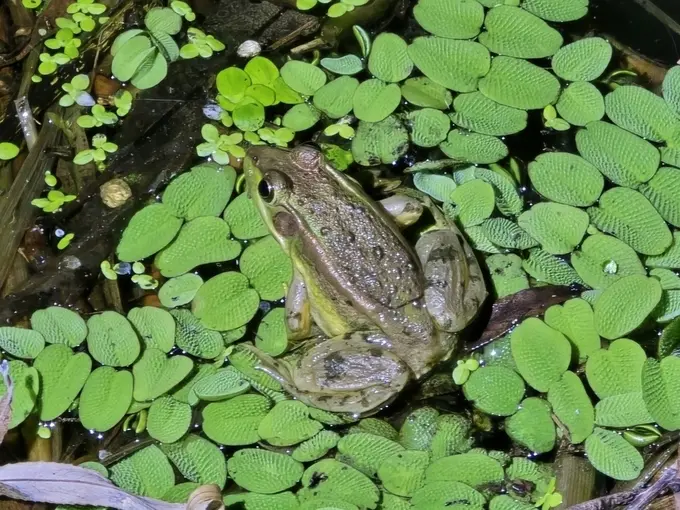
2026.10.28. The Fair Economy — Incheon Green Alliance has called on the city of Incheon and the Han River Basin Environmental Office to fully reconsider the Samsan District 4 urban development project after the habitat of the endangered gold-spotted pond frog was confirmed at the site. The project site covers about 700,000 square meters in the Samsan-dong area of Bupyeong District, and a detailed survey by the developer confirmed the presence of the gold-spotted pond frog and the narrow-mouth frog among 23 legally protected species found there.
In a statement issued on the 28th, Incheon Green Alliance said that despite the confirmed presence of the gold-spotted pond frog noted in the city of Incheon's publicly released document, "Results of Public Comment Collection and Whether They Were Reflected in the Draft Strategic Environmental Impact Assessment for the Samsan District 4 Urban Development Project," the development plan is set to proceed unchanged.
The alliance pointed out that although the developer proposed creating a wetland park within the area to relocate the golden frogs, the effectiveness of the alternative habitat has not been sufficiently verified.
The Samsan District 4 urban development project involves building apartment complexes and commercial facilities on roughly 700,000 square meters around 325 Samsan-dong, Bupyeong District. The site is one of the few remaining large-scale rice paddy wetlands in inland Incheon, functioning as wildlife habitat and an ecological space that helps form urban wind corridors, ease the heat island effect, and reduce air pollution.
The developer identified 23 legally protected species through literature and on-site surveys, and confirmed the presence of golden frogs and Korean fire-bellied toads in additional detailed investigations.
The developer then proposed, instead of preserving the existing habitat, turning a neighborhood park within the site into a wetland, relocating the frogs there, and monitoring them for three years. The alliance's demands — that the Samsan rice paddy wetland be preserved in its original form and the development project be fully reconsidered — were not reflected. The alliance stressed that once an endangered species' habitat is confirmed, the appropriateness of the development plan and the possibility of preserving the existing habitat should be examined first.
The alliance pointed out that the area of the alternative habitat is only about 1.8% of the original habitat, raising doubts about its effectiveness. It explained that it has observed cases where endangered amphibians relocated to alternative habitats during development projects were not properly managed or were damaged.
The alliance urged consideration of alternatives such as turning the Samsan rice paddy wetland into an urban agricultural park or an ecological conservation space. It argued that if the development plan is maintained with only mitigation measures offered, despite the confirmed presence of an endangered species and calls for preserving the large-scale rice paddy wetland, it raises doubts about whether the strategic environmental impact assessment is fulfilling its intended role.
The Samsan District 4 urban development project had long been stalled by disputes among private developers before entering the administrative process in October last year. About 500 billion won (about $350 million) is to be invested, with residential and commercial sites to be built with a target completion date of 2029. The project site is known as the last undeveloped area in Bupyeong District.
A public hearing on the draft strategic environmental impact assessment was held on March 31 at the Bupyeong Safety Experience Center in Incheon. Attendees raised concerns about noise, odor, and inadequate measures for protected species. Park Ju-hui, secretary-general of Incheon Green Alliance, who took part as a resident panelist, said, "The developer confirmed the endangered species' habitat through literature review and only partial field surveys, so it is questionable whether an alternative habitat, once created, will function properly."
The nearby Daejang Andong-ne urban development project in Bucheon, which had been stalled for 20 years by building regulations even after the restriction on development zones there was lifted, has recently gained momentum after Gyeonggi Province's Urban Planning Committee approved a plan to raise development density. This is linked to a broader development trend spreading across Gyeyang, Bupyeong, and Bucheon around the Samsan rice paddy wetland, prompting calls for a comprehensive review of cumulative ecological damage that goes beyond the impact of any single project.
This is not the first time the effectiveness of creating alternative habitats has been questioned. In July, ecologists in Korea and abroad criticized a bird alternative habitat plan proposed by the Ministry of Land, Infrastructure and Transport for the Saemangeum New Airport construction project, saying it rested on the unrealistic assumption that "birds would recognize human-drawn boundaries" and was therefore ineffective.
Experts pointed out that endangered species showing strong fidelity to specific habitats have difficulty surviving stably in artificially created, limited spaces, and stressed that for the gold-spotted pond frog and the narrow-mouth frog, which inhabit wide areas, the effectiveness of relocation to alternative habitats must be verified more rigorously.


0 Comments
No comments yet.