
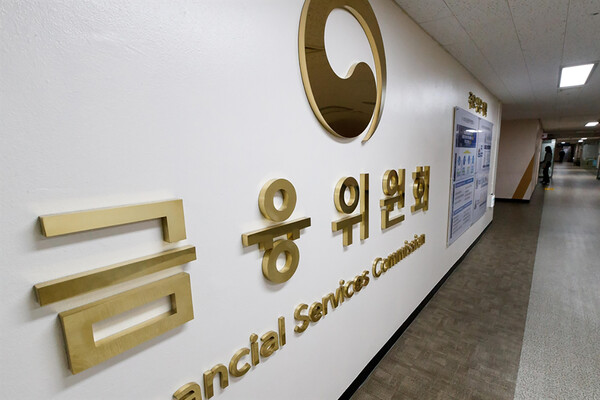
2026.11.04. The Fair Economy — The Financial Services Commission (FSC) finalized its decision to impose fines and penalties on seven banks for violating the Act on the Protection of Financial Consumers (Financial Consumer Protection Act) in connection with the mis-selling of Hong Kong H-index equity-linked securities (ELS). The banks were fined a total of 361.96 billion won (about $259 million), with penalties of 1.778 billion won (about $1.3 million). Six brokerages were fined 9.282 billion won (about $6.6 million) and faced penalties of 1.612 billion won (about $1.2 million). Combined, the fines and penalties for the banks and brokerages come to about 374.6 billion won (about $268 million).
The FSC said it finalized the sanctions on November 4 at its 19th regular meeting.
The violations include failure to fulfill the duty to explain and breaches of the suitability principle. The FSC said the sanctions mark the first case of Financial Consumer Protection Act violations involving a large number of financial consumers and targeting major financial institutions. The amount imposed is the largest monetary sanction the FSC has ever levied.
The FSC said it conducted multiple rounds of deliberation, based on thorough legal review and sufficient fact-finding, to ensure a strict and reasonable decision in line with law and principle. The FSC said the decision makes clear that financial companies face strict accountability under law and principle for violations of the Financial Consumer Protection Act, including mis-selling.
By bank, the fines were 172.334 billion won (about $123 million) for KB Kookmin Bank, 92.475 billion won (about $66 million) for Hana Bank, 40.175 billion won (about $29 million) for NH Nonghyup Bank, 38.745 billion won (about $28 million) for Shinhan Bank, 17.9 billion won (about $12.8 million) for Standard Chartered Bank Korea Limited, and 331 million won (about $236,000) for S Woori Bank. The National Federation Of Fisheries Cooperatives received no fine, only a penalty. The penalties were 1.3 billion won (about $930,000) for KB Kookmin Bank, 420 million won (about $300,000) for NH Nonghyup Bank, 42 million won (about $30,000) for the National Federation Of Fisheries Cooperatives, and 16 million won (about $11,000) for Standard Chartered Bank Korea Limited.
By brokerage, the fines were 9.245 billion won (about $6.6 million) for Korea Investment & Securities Co., 23 million won (about $16,000) for NH Investment & Securities, 10 million won (about $7,000) for Shinhan Investment Corp., and 4 million won (about $2,900) for Mirae Asset Securities. KB Securities and Samsung Securities received no fines. The penalties were 1 billion won (about $710,000) for Samsung Securities, 300 million won (about $214,000) each for Mirae Asset Securities and KB Securities, and 12 million won (about $8,600) for Korea Investment & Securities Co. NH Investment & Securities and Shinhan Investment Corp. received no penalties.
The banks used asset management explanatory materials that either omitted backtesting results showing simulated rates of return — meant to explain investment risk — or changed the analysis period to, for instance, 10 years. The products in question were equity-linked trusts (ELTs) incorporating ELS linked to the H-index. This resulted in the omission of material information that could significantly affect consumers' ability to make reasonable decisions.
Some banks oversimplified their explanations of H-index ELT products, describing profit and loss structures merely as being determined by changes in the underlying asset. As a result, they omitted explanations of the price volatility risk of the underlying asset, which determines the likelihood of losses. Some banks recommended and sold the products based on investor-suitability assessments that did not take into account retail customers' financial circumstances.
The brokerages violated their duty to explain by omitting cautionary notes on risk ratings. The amounts imposed also included sums related to violations of the suitability principle and the prohibition on improper solicitation under the Financial Consumer Protection Act. Six brokerages — Mirae Asset Securities, KB Securities, Shinhan Investment Corp., NH Investment & Securities, Korea Investment & Securities Co. and Samsung Securities — were sanctioned.
The FSC plans to swiftly and strictly sanction violations of the Financial Consumer Protection Act and its subordinate regulations, including mis-selling, and will actively pursue the recovery of unjust gains through fines. Because there have been criticisms that consumer protection at the point of sale remains insufficient under the current system, the FSC will also pursue institutional improvements in parallel. Guidelines for explaining investment products are set to take effect in the first quarter of next year.
A bill to revise the Financial Consumer Protection Act, centered on establishing principles for financial consumer protection, is pending in the National Assembly. The FSC plans to actively participate in the Assembly's bill review to expedite the revision. Under the principles, financial companies would be required to conduct their financial product sales business in a way that serves the best interests of financial consumers and to reflect this in their internal control standards. Compliance with the principles could serve as grounds for reducing sanctions.
The FINANCIAL SUPERVISORY SERVICE (FSS) initially calculated the banking sector's fines at about 4 trillion won (about $2.86 billion), then lowered the figure to about 2 trillion won (about $1.43 billion) in a preliminary notice issued in November 2025. At its sanctions review committee in February 2026, it settled on fines of around 1.4 trillion won (about $1 billion) along with an institutional warning. After the FSC sent the matter back at its regular meeting on May 13, the FSS adjusted the severity ratings for the violation's motive and method from "medium" to "low" at an emergency sanctions review on June 4.
As a result, the combined fines for the five banks — KB Kookmin Bank, Shinhan Bank, Hana Bank, NH Nonghyup Bank and Standard Chartered Bank Korea Limited — fell to around 600 billion won (about $429 million). This is the first time in eight years, since the FSC's 2018 request for a re-review of Samsung Biologics' accounting standard violations, that the FSC has differed with the FSS on a major sanctions matter. The final confirmed amount of 361.9 billion won (about $259 million) is about one-tenth of the initially calculated figure.
Additional grounds for penalty reduction have also been revealed. Reports say the FSC reduced penalties by 30% to 40% for each company under financial consumer protection supervision rules. Factors considered include banks using about 1.4 trillion won ($950 million) in voluntary compensation, exceeding the amount of unjust gains; some banks winning related civil lawsuits; and damages occurring during the initial guidance period of the Financial Consumer Protection Act. The rules allow basic surcharges to be reduced by up to 50% if post-hoc efforts to recover damages are recognized, and by up to 75% if preventive efforts are also recognized.
The issue emerged after the H-index, which stood at around 12,000 in February 2021, fell to around 5,400 by January 2024. As of November 2023, the financial sector's outstanding balance of H-index ELS sales stood at 19.3 trillion won (about $13.8 billion), of which banks accounted for 15.9 trillion won (about $11.4 billion) and brokerages for 3.4 trillion won (about $2.4 billion). In the first half of 2024 alone, maturing products were estimated to have incurred losses of about 4.6 trillion won (about $3.3 billion).
In March 2024, the FSS proposed dispute mediation guidelines that apply differentiated liability of 0 to 100 percent between sellers and investors. Since then, the cumulative compensation paid by five banks reached 1.3437 trillion won (about $960 million) as of early 2026, with about 97 percent of enrolled customers having received compensation.
In January 2026, a court ruled in favor of KB Kookmin Bank in a lawsuit filed by an investor in Hong Kong ELS. The court found it difficult to recognize a violation of disclosure duties solely because the bank did not present 20-year yield simulation results. The FINANCIAL SUPERVISORY SERVICE stated that the investor had extensive experience and a large investment amount, making the case special and hard to generalize.


0 Comments
No comments yet.